

The Best Tattoo Healing Ointment for Fresh Ink Right Now
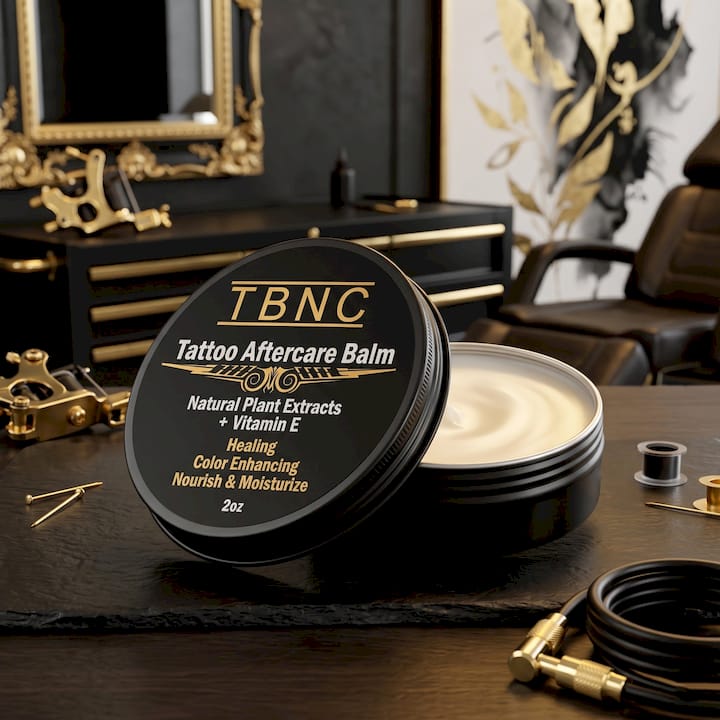
For most fresh tattoos, TBNC Tattoo’s Aftercare Balm is the strongest overall pick because it pairs a dermatologist-approved moisturizing formula with real barrier-repair ingredients, not just fragrance and filler. It does the job an open wound actually needs done: lock in hydration without smothering the skin.
If you want other options in the same category, look for:
- A refined petrolatum-based healing ointment for heavy early-stage protection
- A hypoallergenic healing ointment if you have reactive or easily irritated skin
- A lightweight, unscented lotion for the second half of healing
Switch from ointment to lotion once visible scabbing has mostly resolved, typically somewhere between day 7 and day 14. That single swap prevents the most common aftercare mistake: staying too heavy for too long.
Key Takeaways
The most effective tattoo healing routine uses a dermatologist-approved balm for the first few days, then transitions to a lighter lotion as scabbing resolves.
| Point | Details |
|---|---|
| Start heavy, finish light | Use a barrier-repair balm for days 1 to 4, then switch to lotion as crusting clears. |
| Thin layers only | A rice-grain-sized amount spread thin prevents maceration and speeds healing. |
| Watch for allergens | Skip fragrance, alcohol, and topical antibiotics like neomycin unless a doctor advises otherwise. |
| Twice-daily consistency wins | Clinical tracking over 14 days showed better comfort and repair with steady twice-daily ointment use. |
| TBNC Tattoo fits every stage | The Aftercare Balm, Unscented Lotion, and Soothing Gel each match a specific healing phase in the bundle. |
Table of Contents
- Which tattoo aftercare products actually work best?
- How do you apply tattoo ointment correctly?
- What ingredients should you look for or avoid?
- What does dermatology research say about tattoo aftercare?
- Which TBNC Tattoo aftercare products fit your healing stage?
- Sources
- FAQ
Which tattoo aftercare products actually work best?
Tattoo artists rarely agree on one brand, but they agree on categories. Once you understand the categories, picking a product for your skin type and healing stage gets a lot simpler.
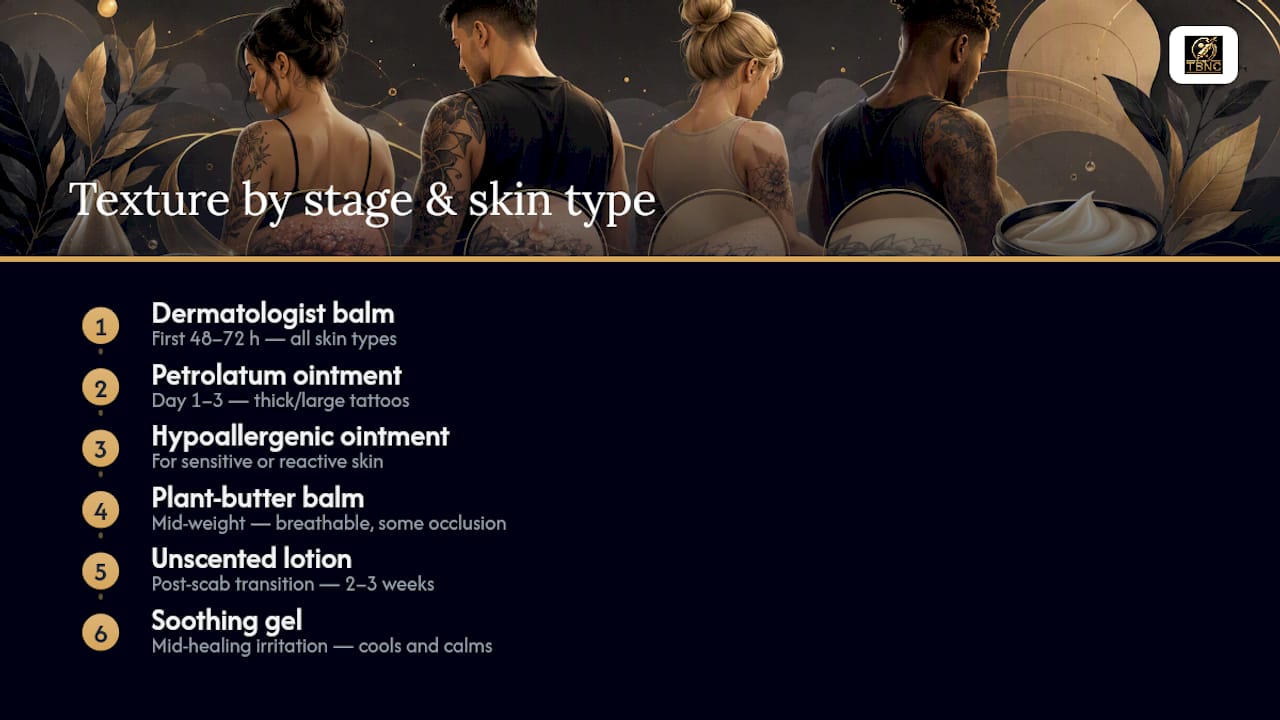
Dermatologist-approved aftercare balm. This is TBNC Tattoo’s own formulation, built for the first several days when your skin is essentially an open wound. It’s a medium-weight balm rather than a heavy grease, which matters because over-occluding fresh skin can trap bacteria and slow healing. Best for: first 48 to 72 hours, all skin types. Texture: balm, heavier than lotion but lighter than pure petrolatum jelly.
Refined petrolatum-based healing ointment. The classic occlusive option. It hydrates by sealing water into the skin rather than adding moisture itself, which is exactly why petrolatum-based ointments work well early but become less breathable as healing progresses. Best for: day 1 through day 3, thick-lined or larger tattoos that need extra protection.
Hypoallergenic healing ointment. Formulated with minimal ingredient lists and no fragrance, this category matters most for anyone with a history of eczema, contact dermatitis, or reactive skin as explained on over-the-counter medications for skin care and wound care. Expert shopping panels consistently steer sensitive-skin readers toward fragrance-free, dermatologist-tested formulas over scented alternatives.
Plant-butter balms. Shea butter and beeswax blends sit between ointment and lotion in weight. They’re popular with artists who want something a little more breathable than petroleum-based products while still providing real occlusion.
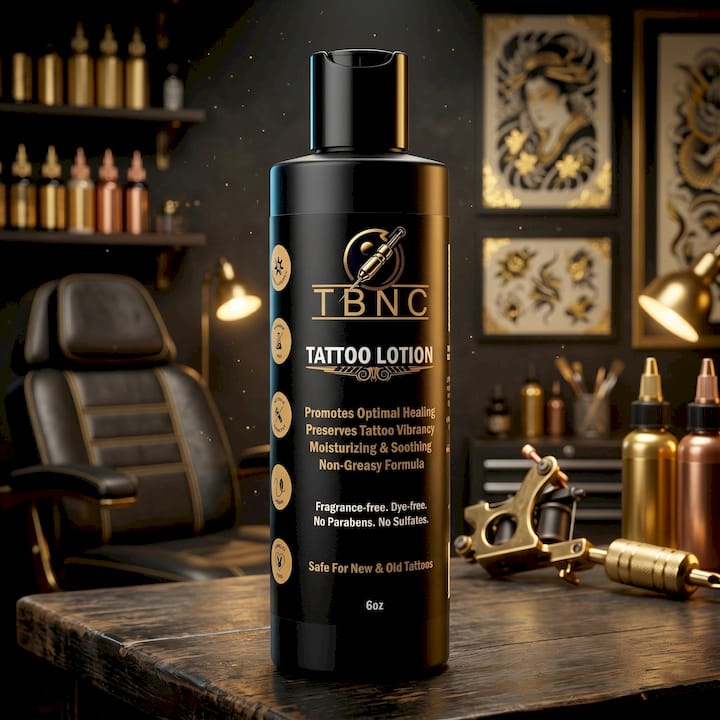
TBNC Tattoo Unscented Lotion. Once scabbing eases, this is your transition product: lighter, faster-absorbing, and built for the two to three weeks of ongoing moisturization your skin needs after the crusting phase.
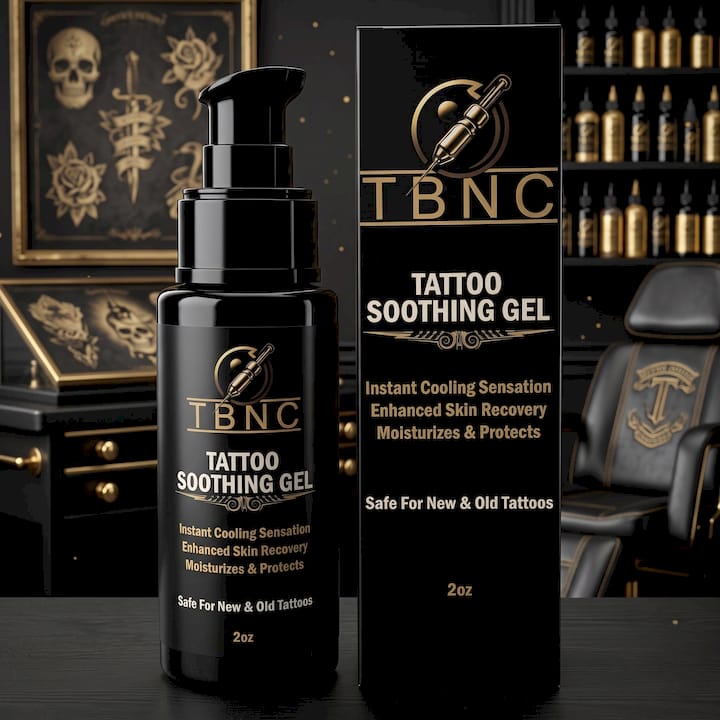
TBNC Tattoo Soothing Gel. For irritation, tightness, or redness that shows up mid-healing, a gel format cools and calms without adding heavy occlusive weight. The full profile of why a soothing gel changes the healing experience is worth a look if you’re deciding between gel and lotion.
Pro Tip: If you’re not sure which texture you need, go by feel: if your skin still looks shiny, tight, or scabbed, you need ointment. If it looks matte and flaky, you need lotion.
How do you apply tattoo ointment correctly?
Healing a tattoo isn’t complicated, but the timing and the amount both matter more than people assume. Here’s the checkpoint-by-checkpoint plan.
- Day 0 (in-studio): Your artist cleans the tattoo, applies a thin layer of ointment, and covers it with a bandage or clear film. Leave that on for the amount of time your artist specifies, usually a few hours.
- Days 1 to 3: Wash gently with lukewarm water and mild soap twice a day, then pat dry and apply a thin layer of ointment. Cleveland Clinic’s aftercare guidance recommends this twice-daily rhythm specifically to prevent scabbing from building up too thick.
- Days 4 to 7: Keep moisturizing to control scabbing, but watch for maceration, which shows up as pale, softened, or overly wet-looking skin. That’s your sign you’re using too much product.
- Days 8 to 14: As crusting resolves, switch to a lighter lotion. This is the point where continuing with heavy ointment does more harm than good.
Do this:
- Use an amount roughly the size of a grain of rice per application, spread thin
- Wash before every application, always with clean hands
- Wear loose clothing over the tattoo for at least the first week
Avoid this:
- Soaking the tattoo in pools, baths, or hot tubs during healing
- Re-applying ointment before the last layer has fully absorbed
- Picking or scratching scabs, even when they itch
Pro Tip: A “thin layer” should almost disappear into the skin within a minute. If you can still see a visible sheen of product ten minutes later, you applied too much.
What ingredients should you look for or avoid?
Not every ointment on a shelf deserves a spot on your fresh tattoo. Some ingredients help skin repair itself; others just look good on packaging.
Look for:
- Glycerin and hyaluronic acid (humectants that pull in moisture)
- Panthenol (supports skin barrier repair)
- Ceramides (rebuild the skin’s protective layer)
- Gentle occlusives like petrolatum or beeswax, in moderate amounts
Avoid:
- Added fragrance, a common irritant on broken skin
- Alcohol-based formulas, which dry out healing tissue
- Topical antibiotics like neomycin or bacitracin, which dermatology-adjacent shopping guides warn can cause allergic contact dermatitis and usually aren’t necessary for routine healing
Before committing to a full-tattoo application, patch-test any new product on a small, unbroken patch of skin near (not on) the tattoo for 24 hours. If your skin runs oily, lean toward lighter gels and lotions sooner. Dry or sensitive skin usually does better sticking with a hypoallergenic balm longer before switching.
What does dermatology research say about tattoo aftercare?
The clinical case for ointment-based aftercare isn’t just tradition. A small clinical study tracking twice-daily use of a dermo-cosmetic ointment over 14 days found meaningful improvement in both discomfort and skin repair quality, with redness largely resolved by the end of that window in most subjects.
The research points to a simple principle: moisturize consistently until crusting disappears, then keep moisturizing with a lighter product for two to three more weeks. It’s not about applying more product. It’s about applying the right amount at the right stage.
This lines up with the European standard NF EN 17169, which literature in this space cites as guidance for thin-layer ointment application repeated a few times daily rather than one heavy coat. The American Academy of Dermatology treats a fresh tattoo as an open wound, and its guidance is blunt: support the skin’s natural regeneration, don’t try to out-treat it. That’s the whole philosophy in one line.
Why TBNC Tattoo builds its aftercare line around this timeline
We built our aftercare formulas around one idea: tattoos heal best when the ointment does less, not more. Dermatologist input shaped our ingredient choices specifically to avoid the fragrance and heavy occlusives that show up in generic products. In studio workflows we’ve seen firsthand, artists apply a thin layer immediately after tattooing, then clients continue twice daily at home before transitioning to lotion. That rhythm isn’t a guess. It’s the pattern that keeps showing up across clinical guidance.
Which TBNC Tattoo aftercare products fit your healing stage?
Matching product to timeline is the whole game. For the first two to four days, TBNC Tattoo’s Aftercare Balm gives you the barrier support fresh skin needs without the greasy over-occlusion that causes maceration. Once scabbing starts resolving, move to the Unscented Aftercare Lotion for lighter, ongoing hydration through the two-to-three-week tail end of healing. If irritation or tightness shows up mid-process, the Soothing Gel calms things down fast without adding weight.
If you’d rather not piece together separate products, the Tattoo Numbing & Aftercare Bundle covers the full stretch from numbing before the session to healing afterward, and it’s a simpler, better-value way to buy once instead of three times. Browse the full aftercare collection to see what fits your skin and your artist’s specific instructions. Always defer to your studio’s exact aftercare directions, and patch-test any new product first if you have sensitive or reactive skin.
Sources
- Tattoo aftercare management with a dermo‐cosmetic product: Improvement in discomfort sensation and skin repair quality - PMC
- Tattoo aftercare | Cleveland Clinic
- Caring for tattooed skin | American Academy of Dermatology (AAD)
- Aquaphor for tattoos: Is this recommended for aftercare? | Healthline
- Tattoo aftercare explained by medical evidence (practitioner commentary) | Acıbadem International
FAQ
Why do tattoo artists say not to use Aquaphor?
Some artists avoid heavy petrolatum-based ointments like Aquaphor because over-application can trap moisture against the skin, leading to maceration and slower healing. It’s not the ingredient itself but the tendency toward thick, frequent application that causes problems.
Which is better for tattoos, Aquaphor or A&D ointment?
Both are petrolatum-based and work similarly for the first few days. The real difference comes down to added ingredients. A&D often contains lanolin and vitamins, which some sensitive skin types react to, while pure petrolatum-based formulas tend to have fewer potential irritants.
What should you put on a tattoo to heal it faster?
A thin layer of dermatologist-approved ointment for the first few days, followed by a switch to unscented lotion once scabbing resolves, matches the approach clinical guidance supports for reduced redness and better skin repair.
What cream do tattoo artists recommend?
Recommendations vary by studio, but artists generally point toward fragrance-free, minimal-ingredient balms for the first few days and lighter lotions afterward. TBNC Tattoo’s Aftercare Balm and Unscented Lotion are built specifically around that two-stage approach.
How do I know if I’m allergic to my tattoo ointment?
Watch for increased redness, itching, or small bumps that appear beyond the normal healing pattern, usually within a day or two of applying a new product. If that happens, stop use and switch to a hypoallergenic, fragrance-free option.


