

Best Tattoo Moisturizer for New Tattoos: Expert Picks by Timeline
For the first couple of days after your session, use a thin layer of a fragrance-free, alcohol-free GHK-Cu Lotion | Neurogan Health at Healthspan Holistic occlusive ointment. Then switch to a dye-free lotion loaded with barrier-repair ingredients like panthenol, glycerin, or ceramides for the following weeks. That switch, not brand loyalty or price tag, is what separates a tattoo that heals crisp and vibrant from one that scabs hard, itches, and fades early.
Do three things right now if you’re staring at fresh ink. First, wash it gently with a fragrance-free cleanser and pat it dry with a clean paper towel, never a bath towel. Second, apply a thin, almost invisible sheen of an unscented ointment or aftercare balm, the kind dermatologists recommend for tattooed skin. Third, check every product label in your bathroom for fragrance, dyes, or alcohol before it touches that skin. If you’ve ever had eczema, contact allergies, or reacted to lotions before, patch-test anything new on healed skin first before applying it to a fresh tattoo.
Key Takeaways
The safest tattoo healing routine uses an unscented occlusive ointment initially, then switches to a fragrance-free lotion with barrier-repair actives for several weeks afterward.
| Point | Details |
|---|---|
| Two-phase timeline | Use ointment for days 0 to 3, then fragrance-free lotion for days 3 through 21. |
| Fragrance is the top risk | Scented lotions are linked to allergic contact dermatitis and permanent pigment fading. |
| Apply thin, not thick | A slight sheen is enough; heavy layers trap moisture and raise infection risk. |
| Watch for warning signs | Spreading redness, pus, or worsening rash means stop the product and seek care. |
| Prioritize ingredients over price | Fragrance-free, dye-free, short ingredient lists matter more than the brand name. |
| TBNC bundle covers the full timeline | The Tattoo Numbing & Aftercare Bundle pairs numbing cream with fragrance-free lotion and balm in one purchase. |
Table of Contents
- What Is the Best Tattoo Moisturizer, and When Should You Use It?
- Quick Picks: Which Product to Use and When
- How Do You Choose the Right Tattoo Aftercare Cream?
- When Should You Switch From Ointment to Lotion?
- Which Ingredients Help Tattoos Heal, and Which Ones Hurt Them?
- How Do You Apply Tattoo Moisturizer the Right Way?
- What Can Go Wrong, and When Should You See a Doctor?
- Why Dermatology Guidance Backs This Approach
- Do Testimonials and Studies Back Up These Products?
- What Tattoo Artists Wish Every Client Understood
- A Ready-Made Option: TBNC’s Aftercare Bundle
- Sources
- FAQ
What Is the Best Tattoo Moisturizer, and When Should You Use It?
There’s no single “best” product, because your skin needs two different jobs done at two different times. Immediately after tattooing, you want an occlusive, something that seals the wound and slows fluid loss. A week or two later, once the surface has closed and started peeling, you want an emollient lotion that hydrates without smothering. Confusing the two, or sticking with one product too long, is the single most common mistake new clients make.
That’s also why “best tattoo moisturizer” searches get messy fast. Some guides push a single lotion for the entire healing window. Tattoo artists and dermatology sources tend to agree on something more nuanced: an occlusive ointment first, then a switch to unscented lotion for two to three weeks. That two-step approach is the standard this guide is built around.
Quick Picks: Which Product to Use and When
If you want a fast answer before you read the reasoning, here’s the shortlist mapped to your healing calendar.
- Days 0 to 3, initial wound care: An unscented, petrolatum-style balm like TBNC’s Tattoo Aftercare Balm. It seals moisture in and forms a barrier against airborne bacteria while the wound is most vulnerable.
- Days 3 to 7, early peeling: The same balm in a thinner layer, or a lightweight soothing gel if the area feels hot or itchy rather than dry.
- Days 7 to 21, switch-to-lotion phase: A fragrance-free, dye-free lotion, such as TBNC’s Tattoo Aftercare Lotion Unscented, applied two to three times daily.
- Sensitive or reactive skin: Whichever option has the shortest ingredient list. Fewer additives means fewer chances for a reaction.
- First-timers who want one purchase for the whole timeline: A combined kit like TBNC’s Tattoo Numbing & Aftercare Bundle, which pairs numbing prep with the aftercare products above.
On price, budget-tier lotions from the drugstore aisle and mid-tier tattoo-specific formulas often share nearly identical ingredient decks. Value here comes from ingredient transparency and fragrance-free formulation, not the size of the price tag, according to reporting on tattoo aftercare products. TBNC’s line sits in the mid-tier range, priced to match dermatologist-aligned formulation rather than boutique markup.
How Do You Choose the Right Tattoo Aftercare Cream?
Run every product through the same checklist before it goes anywhere near new ink. Look for fragrance-free, alcohol-free, and dye-free on the label, since these three exclusions are the core dermatology guidance for tattooed skin. Beyond that, check whether the formula leans occlusive (thick, waxy, meant to seal) or emollient (lighter, meant to hydrate ongoing), because you need both types at different points.
Ingredient count matters more than most people expect. A short ingredient list cuts your odds of an unexpected reaction. Watch specifically for these red flags on any tattoo aftercare label:
- Added fragrance or “parfum,” even in small amounts.
- Essential oil blends marketed as “natural” or “aromatherapy.”
- Ethyl alcohol or denatured alcohol, which dries and irritates.
- Neomycin, polysporin, or other topical antibiotics unless your artist or doctor specifically prescribed them.
- Artificial dyes or colorants that serve no healing function.
Marketing claims like “clinically proven” or “artist recommended” sound authoritative but carry no regulatory weight on their own. What matters is the actual ingredient panel, not the front-of-bottle copy.
Pro Tip: If you have a history of eczema, psoriasis, or contact allergies, dab a small amount of any new product on the inside of your forearm 48 to 72 hours before your tattoo appointment. If nothing flares, it’s very likely safe to use on the healing tattoo itself.
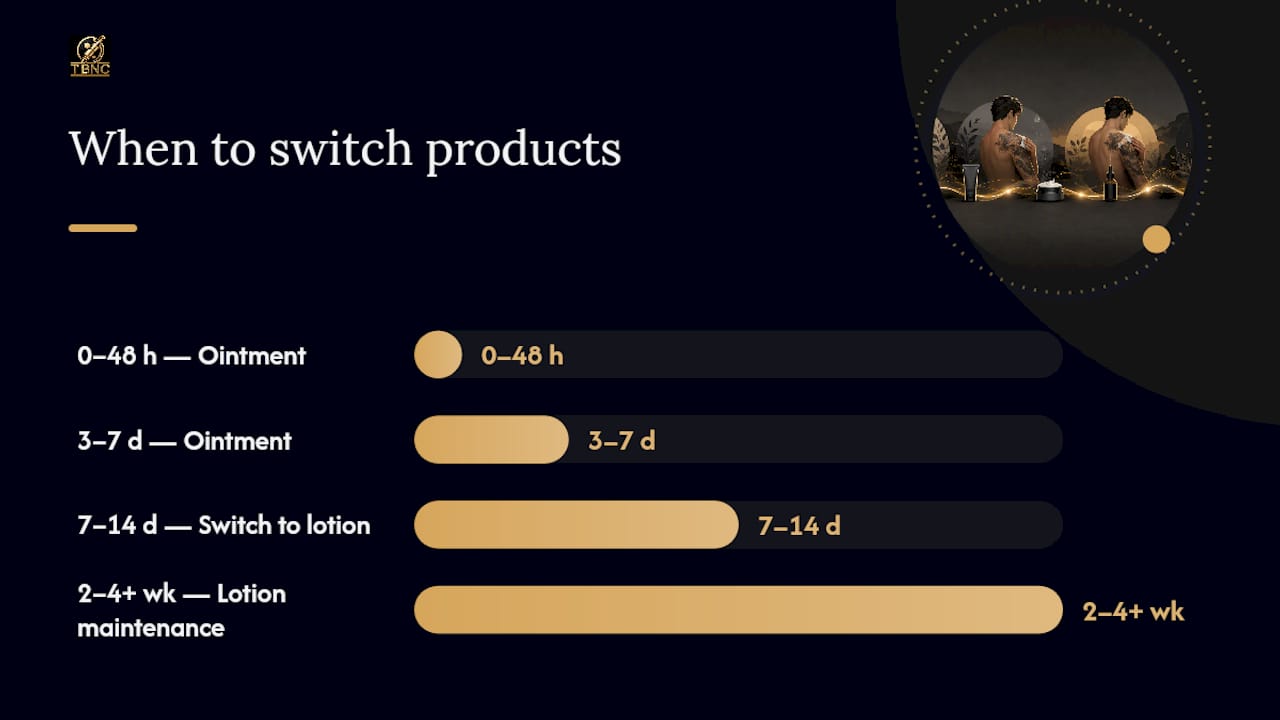
When Should You Switch From Ointment to Lotion?
Healing runs on a fairly predictable clock, and each phase calls for a different texture.
- Hours 0 to 48 (sometimes 72): Keep it simple. Clean gently twice a day and apply a thin layer of unscented ointment. This is when infection risk is highest and the skin is essentially an open wound.
- Days 3 to 7: The tattoo starts to flake and tighten. Continue the ointment, but use less of it. This matches European aftercare guidance under NF EN 17169, which recommends a specific ointment applied two to three times daily during this window.
- Days 7 to 14: Peeling and light scabbing peak here. Switch to a fragrance-free lotion now if you haven’t already. Lotion won’t trap moisture the way ointment does, which matters once the surface has largely closed.
- Weeks 2 to 4 and beyond: Keep applying lotion once or twice daily until the skin feels fully normal again, no tightness, no flaking. After that, moisturizing becomes general skin maintenance rather than wound care.
Ointments and lotions aren’t interchangeable, and using the wrong one at the wrong time causes real problems. An occlusive ointment worn too long can trap sweat and bacteria against skin that no longer needs sealing. A lotion applied too early won’t protect a still-open wound the way an occlusive does.
Stop using any product and contact your artist or a clinician if you notice spreading redness beyond the tattoo border, pus or unusual discharge, swelling that’s getting worse rather than better, or a rash that looks distinctly different from normal healing irritation.
| Dimension | Ointment (occlusive) | Lotion (emollient) |
|---|---|---|
| Best for | Initial wound care, days 0 to 7 | Ongoing hydration, days 7 to 21+ |
| Texture | Thick, waxy, forms a seal | Lightweight, absorbs quickly |
| Key beneficial ingredients | Petrolatum, panthenol, shea butter | Glycerin, ceramides, hyaluronic acid |
| How long to use | 3 to 7 days, tapering | 2 to 3 weeks, or until fully healed |
| Potential irritants | Fragrance, essential oils in “natural” balms | Alcohol, dye, added fragrance |
Which Ingredients Help Tattoos Heal, and Which Ones Hurt Them?
Certain ingredients earn their place in tattoo aftercare because they support the skin’s barrier without introducing risk. Others show up in mainstream lotions for scent or shelf appeal and do measurable harm to healing ink.
| Prefer | What it does |
|---|---|
| Petrolatum / refined occlusives | Seals moisture in, protects the open wound |
| Glycerin | Draws water into the skin, a reliable humectant |
| Panthenol (vitamin B5) | Calms irritation and supports barrier recovery |
| Ceramides | Rebuilds the skin’s natural lipid barrier |
| Hyaluronic acid | Holds moisture in the upper skin layers |
| Shea butter | Softens and conditions without heavy fragrance load |
| Avoid | Why it’s a problem |
|---|---|
| Added fragrance | Leading cause of allergic contact dermatitis on new tattoos |
| Ethyl or denatured alcohol | Dries skin and delays healing |
| Essential oil blends | Common allergen source disguised as “natural” |
| Neomycin or topical antibiotics | Unnecessary without a prescription, raises allergy risk |
| Artificial dyes | No healing benefit, added irritant potential |
A documented case report tracked a patient who developed allergic contact dermatitis after using a scented lotion on a fresh tattoo. The reaction didn’t just delay healing. It caused visible scarring and permanent fading of the pigment underneath, turning a cosmetic choice into a lasting change to the artwork itself.
That single case is why fragrance-free isn’t a marketing preference in this category. It’s the line between a tattoo that heals clean and one that scars. If you’ve had contact dermatitis or severe eczema before, patch-test any new aftercare product on healed skin first, and flag your history to your artist before your appointment.
How Do You Apply Tattoo Moisturizer the Right Way?
Getting the amount and timing right matters more than which specific brand sits in your bathroom cabinet. Here’s the routine, step by step:
- Wash your hands thoroughly before touching the tattoo at all.
- Clean the area with a fragrance-free cleanser and lukewarm water, using your fingertips, not a washcloth.
- Pat dry with a clean paper towel. Never rub, and never reuse a bath towel on the tattoo.
- Apply a thin layer of your chosen product, just enough to leave a slight sheen on the skin.
- Let it absorb fully before covering with clothing, and leave it uncovered whenever you can.
- Repeat two to three times daily during the lotion phase; ointment phase needs less frequent, thinner applications.
Some rules are worth repeating because people get them wrong constantly:
- Do use clean hands or a clean cotton pad for every application.
- Do apply just enough to see a light sheen, not a glossy, wet-looking layer.
- Don’t re-bandage the tattoo unless your artist specifically told you to.
- Don’t apply a thick coat “to be safe.” Clinical guidance is explicit that over-moisturizing traps fluid against the skin and raises infection risk, the opposite of what most people assume.
- Don’t switch products daily out of impatience. Give each phase its full window before changing course.
What Can Go Wrong, and When Should You See a Doctor?
Two very different problems can look similar on day four or five: infection and allergic contact dermatitis. Telling them apart quickly changes what you should do next.
Infection tends to bring fever, pus or cloudy discharge, red streaking that spreads outward from the tattoo, and pain that gets worse instead of better after the first couple of days. Allergic contact dermatitis usually shows up as an intensely itchy rash with a defined border, often appearing shortly after you start using a new product rather than in the first hours after the tattoo itself.
- If you suspect a reaction, stop the product immediately and switch to plain, fragrance-free petroleum jelly until you can consult a professional.
- Keep the area clean but don’t scrub it.
- Take a photo every day so you and your artist (or doctor) can track whether it’s improving or spreading.
- Contact your tattoo artist first for a healing-stage opinion, and seek medical attention promptly if you see fever, spreading redness, or pus.
The case report on scented-lotion dermatitis mentioned earlier is worth remembering here specifically because the damage outlasted the reaction itself: permanent fading where the allergic response had been most severe. If a reaction ever recurs across more than one product, a dermatologist can run formal patch testing to identify the specific culprit ingredient.
Pro Tip: If you’re not sure whether what you’re seeing is normal healing or a problem, compare it to how the tattoo looked the day before, not to what you expect a “perfect” healing tattoo to look like. Steady improvement, even if slow, is normal. Getting worse day over day is the signal to act.
Why Dermatology Guidance Backs This Approach
The fragrance-free, alcohol-free, staged-moisturizing approach isn’t a house preference. It reflects consistent dermatology guidance and clinical observation. The American Academy of Dermatology names shea butter, vitamin E, panthenol, glycerin, and ceramides as ingredients worth prioritizing for tattooed skin, and a small clinical survey of a dermo-cosmetic ointment found reduced redness and swelling with high tolerability when applied consistently for the first 14 days.
TBNC Tattoo builds its aftercare line around that same logic: balms and gels formulated without fragrance or dye for the early wound-care window, and an unscented lotion for the longer hydration phase. The brand’s numbing and aftercare products are used across more than 3,250 tattoo studios worldwide and have been part of over one million tattoo sessions, adoption numbers that reflect trust from professional artists who see healing outcomes daily rather than occasionally. That scale doesn’t substitute for a dermatologist’s individual advice, but it does mean the formulations have been through real-world use at a volume most boutique aftercare brands never reach.
Do Testimonials and Studies Back Up These Products?
Client feedback and clinical literature point in the same direction, even though they’re measuring different things. Individual client reports on tattoo aftercare products tend to emphasize the same two outcomes over and over: less itching during the peeling phase and less visible flaking when a fragrance-free lotion replaces ointment on schedule.
On the clinical side, the evidence is modest but consistent. The dermo-cosmetic ointment survey recorded resolved edema and good tolerability across its 14-day observation period, not a large randomized trial, but a real signal that formulation matters. Combine that with the documented harm from scented lotion in the case report above, and the pattern holds: products built around barrier-repair ingredients perform better and safer than scented, alcohol-heavy alternatives marketed on fragrance appeal alone. Neither data point is a guarantee for any individual’s skin, but together they support the same recommendation dermatologists already make.
What Tattoo Artists Wish Every Client Understood
Ask any artist who’s been doing this for more than a few years, and two complaints come up constantly. The first is over-application. Clients see a glossy, thick layer of lotion and assume more product means faster healing. It’s the opposite; a heavy coat traps moisture and sweat against skin that’s trying to close, which is exactly the setup clinical guidance warns against. The second is switching to lotion too early, usually out of impatience during the itchy peeling phase, before the surface has actually closed enough to stop needing an occlusive seal.
Also worth planning for beyond the healing window: once a tattoo is fully closed, sun exposure becomes the biggest long-term threat to how sharp the linework and color stay. UV rays fade ink faster than almost anything else, so a broad-spectrum sunscreen over healed tattoos, every time they’re exposed, matters just as much as getting the first three weeks right. Healing well gets you a crisp tattoo. Protecting it afterward is what keeps it that way for decades.
A Ready-Made Option: TBNC’s Aftercare Bundle
If you’d rather not hunt down separate products for each phase of healing, TBNC’s Tattoo Numbing & Aftercare Bundle covers the full timeline in one purchase. It pairs the brand’s numbing cream for the session itself with the unscented aftercare lotion and balm or soothing gel for the healing weeks that follow, so you’re not guessing which fragrance-free formula to grab at the drugstore on day four.
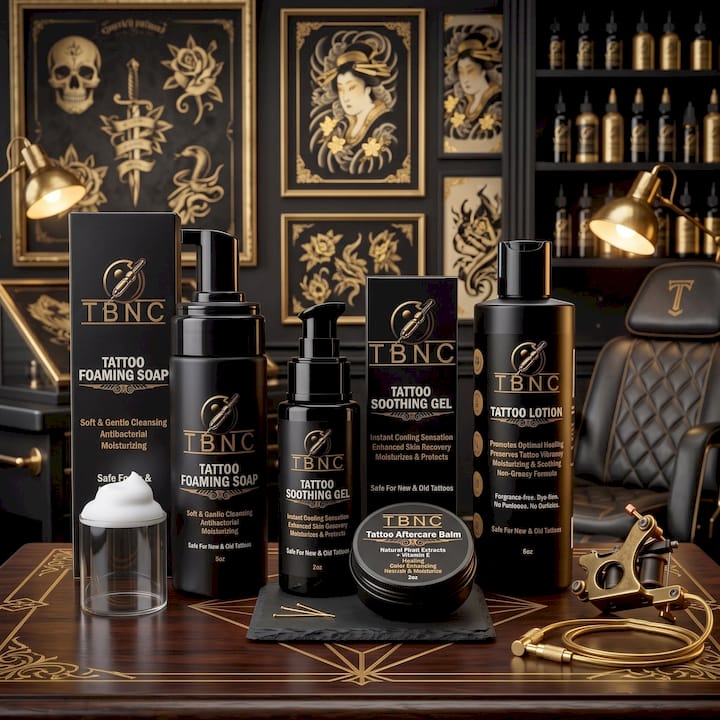
This bundle fits first-time recipients especially well, since it removes the label-reading step entirely; every product inside is already formulated fragrance-free and dye-free along the lines dermatology guidance recommends. It’s also a practical pick for anyone getting multiple pieces done in one sitting, where both pain management and a clear aftercare plan matter from the start. TBNC’s formulations are used across thousands of professional studios, which gives artists and clients alike a consistent reference point instead of piecing together a routine from five different brands. If that sounds like what you need, you can check the bundle’s full contents and pricing here before your next appointment.
Sources
- Caring for tattooed skin — American Academy of Dermatology (AAD)
- Tattoo aftercare — Cleveland Clinic
- Clinical survey and guideline context for tattoo aftercare (PMC9290601)
- Tattoo aftercare — Healthline
This article is general information, not a substitute for advice from a qualified doctor. Consult a qualified healthcare professional about your own circumstances before acting on anything here.
FAQ
What is the best moisturizer for a new tattoo?
An unscented, alcohol-free occlusive ointment for the first 48 to 72 hours, followed by a fragrance-free lotion with panthenol, glycerin, or ceramides for two to three weeks, matches the current dermatology consensus.
Is Aquaphor or Cerave better for tattoos?
Both fall into acceptable categories: Aquaphor works as an early-phase occlusive ointment, while Cerave-style fragrance-free lotions suit the later hydration phase, so the “better” one depends on which stage of healing you’re in.
What cream do tattoo artists recommend?
Most artists recommend a petrolatum-based, unscented ointment immediately after the session, then a fragrance-free lotion once the tattoo starts peeling; TBNC’s balm and unscented lotion follow that same two-step structure.
Does a tattoo heal better dry or moisturized?
Moisturized healing generally reduces itching and the urge to pick at scabs, which lowers the risk of pulling out ink, while dry healing skips that protection and works better mainly for people confident they won’t scratch.
How long should I keep moisturizing a new tattoo?
Continue moisturizing for roughly two to three weeks total, ointment for the first several days and lotion afterward, until the skin feels normal again with no tightness or flaking.


