

How Long to Cover a New Tattoo (And What to Use)
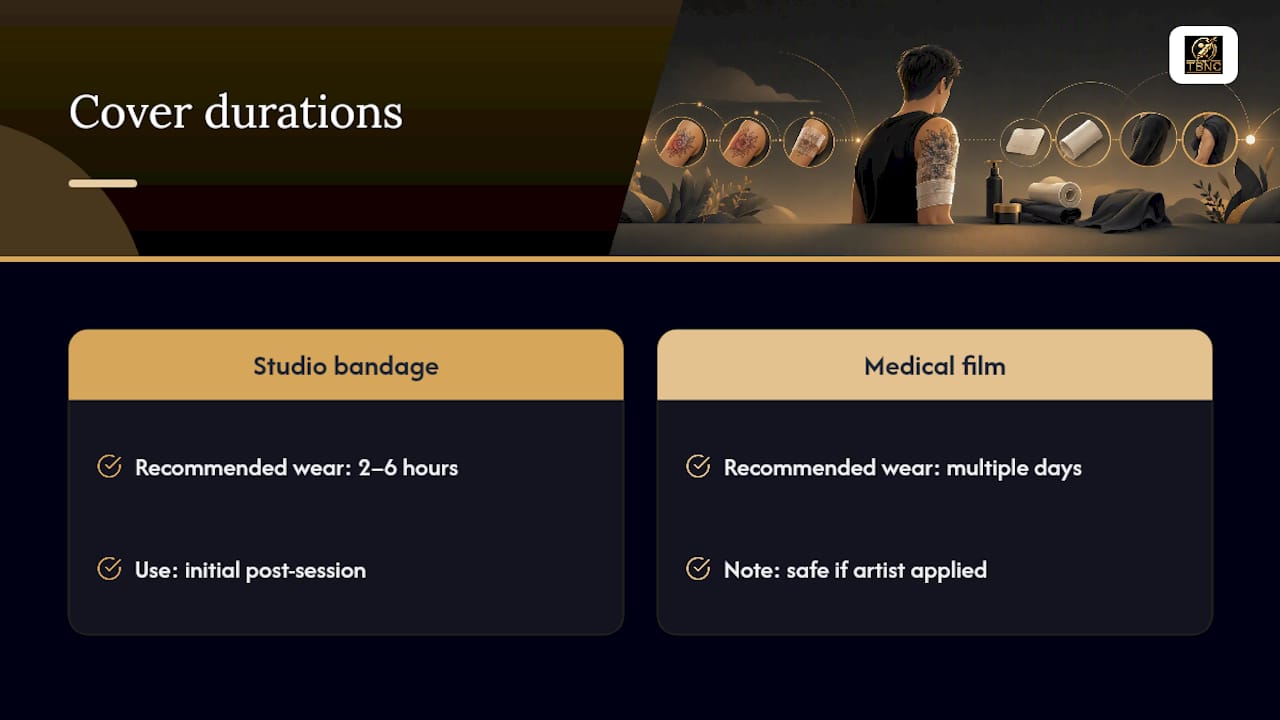
Keep the studio bandage on for a few hours, typically 2 to 6 hours, unless your artist used a medical adhesive film or told you otherwise. Medical-grade films like Saniderm can stay on for multiple days because they’re built to breathe while holding moisture in. What you should never do is swap either of those for a layer of kitchen plastic wrap left on overnight. It traps bacteria against broken skin, and that’s a shortcut to a slow, irritated heal instead of a clean one.
Once you remove that first cover:
- Wash your hands, then wash the tattoo with lukewarm water and a fragrance-free soap.
- Pat it dry with a clean paper towel. Do not rub.
- Apply a thin layer of fragrance-free aftercare and let the skin breathe under loose clothing.
Quick fact: dermatology-aligned guidance treats a fresh tattoo like a controlled wound — the same washing, moisturizing, and monitoring principles that apply to any healing skin injury apply here too.
Key Takeaways
Cover a fresh tattoo with a short initial bandage or a medical film, then switch to breathable, thin-layer aftercare instead of long-term airtight plastic.
| Point | Details |
|---|---|
| Initial bandage timing | Remove the studio wrap in 2 to 6 hours unless a medical film or artist says otherwise. |
| Medical films last longer | Products like Saniderm are designed for multi-day wear because they stay breathable. |
| Avoid airtight plastic long-term | Household wrap left on too long traps bacteria and raises infection risk. |
| Moisturize thin, not thick | A thin layer of fragrance-free product beats a heavy coat every time. |
| Watch for red flags | Spreading redness, pus, fever, or worsening pain means contact a professional. |
| Match products to healing stage | TBNC Tattoo’s unscented lotion and balm fit the thin-layer approach this guide recommends. |
Table of Contents
- When Should You Remove the Initial Bandage on a Tattoo?
- Which Cover Is Best for a Fresh Tattoo?
- How Do You Clean and Re-Cover a Tattoo After Removing the Wrap?
- When Is It Safe to Use Makeup to Hide a New Tattoo?
- What Are the Warning Signs of a Tattoo Infection?
- How Do TBNC Products Fit Into New Tattoo Aftercare?
- What Actually Matters Most in Tattoo Cover Care
- Get the Right Products for a Full Healing Cycle
- Sources
- FAQ
When Should You Remove the Initial Bandage on a Tattoo?
That first bandage isn’t decorative. It’s doing a job: catching plasma that weeps out in the early hours and blocking airborne contaminants while the surface is most vulnerable. Once that plasma has done its work and the skin has started to seal, the bandage becomes less useful and more of a moisture trap.
Timing shifts depending on a few real variables:
- Size and placement matter. A small wrist piece weeps less than a large back panel, so smaller tattoos often tolerate earlier removal.
- Watch how much plasma has collected. If the bandage looks saturated, feels loose at the edges, or picked up dirt or sweat, take it off ahead of schedule rather than waiting out the clock.
- Heavy weeping changes the math. If your artist wrapped you in a medical film like Saniderm specifically because your piece was expected to weep a lot, that film is designed to stay put far longer than a standard 2 to 6 hour window. Follow the product guidance, not the generic rule.
When in doubt, your artist’s specific instructions for your specific piece override any general timeline you read online.
Which Cover Is Best for a Fresh Tattoo?
Not every “cover” does the same job, and picking the wrong one is where most avoidable healing problems start. The real tradeoff running through every option below is protection versus airflow — too much of either creates its own set of problems.
Household plastic wrap is what most studios reach for in the first hour or two because it’s cheap and immediately available. It works fine as a short-term barrier right after the session, but it doesn’t breathe at all. Left on for a day or longer, it holds moisture and heat against the skin, which raises infection risk and can worsen scabbing.
Medical adhesive films, the polyurethane “second-skin” dressings tattoo studios increasingly favor, solve that problem by design. They’re waterproof against outside contamination yet permeable enough to let the skin respire, which is why they’re rated for multi-day wear rather than hours.
Clothing concealment is genuinely the lowest-risk option once the initial wrap comes off. Loose, clean, breathable fabric protects against friction and dust without touching the wound directly.
Adhesive bandages and medical tape sit at the riskier end. Standard bandages weren’t built for this use case, and the adhesive can pull at fragile scabbing when removed. Save wound-specific dressings for situations your artist or a clinician actually recommends.
- Plastic wrap: fast, cheap, but non-breathable and infection-prone if left too long.
- Medical films: breathable, waterproof, built for multi-day wear.
- Loose clothing: lowest friction, lowest cost, no adhesive risk.
- Standard bandages/tape: highest irritation risk, use only when directed.
How Do You Clean and Re-Cover a Tattoo After Removing the Wrap?
The sequence matters more than any single product. Rushing the wash step or slathering on too much ointment causes more problems than it solves.
- Wash your hands first. Every step after this touches open, healing skin.
- Soften the adhesive under warm water before you start peeling. Pulling a dry bandage off tears at scabbing that hasn’t set yet.
- Wash the tattoo itself with lukewarm water and a mild, fragrance-free soap, using your fingertips rather than a washcloth.
- Pat dry with a clean paper towel. Air can finish the job, but don’t let the area sit dripping wet.
- Apply a thin layer of aftercare balm or unscented lotion. Less is genuinely more here — a heavy coat traps moisture underneath instead of letting the skin regulate itself.
- Re-cover only if you need to, for sleeping or a physical job. Use a loose, sterile non-stick pad, or follow your artist’s specific instruction if they set you up with a medical film that’s meant for reapplication.
Skip the petroleum jelly, skip tight synthetic sleeves or leggings that rub against the design, and never scrub or pick at forming scabs, even the itchy ones.
Pro Tip: Apply aftercare product with clean fingertips, not a cotton pad. Cotton fibers can catch on a healing surface and pull at scabbing you’re trying to protect.
When Is It Safe to Use Makeup to Hide a New Tattoo?
Cosmetic cover-up on unhealed skin is a bad trade. Foundation and concealer clog pores that are already working overtime to repair themselves, and the friction of applying and removing makeup disturbs skin that hasn’t finished sealing. Add in the bacteria load most makeup applicators carry, and you’ve built a small infection risk on top of an already sensitive area.
A reasonable rule: wait until the surface is fully intact, not just scab-free, before reaching for concealer. That’s often several weeks out, not several days.
In the meantime, safer concealment options exist:
- Loose layering, like a light long sleeve or an open button-up, hides ink without touching it directly.
- Scarves and looser accessories work for neck or collarbone placements.
- Choose fabric that moves with you instead of clinging, since repeated friction is what actually damages fresh skin.
Once you do reach for makeup, use a fresh sterile applicator each time, pick a non-comedogenic formula, and remove it gently with a mild cleanser rather than a makeup wipe.
What Are the Warning Signs of a Tattoo Infection?
Most healing tattoos go through a predictable rough patch: redness, mild swelling, and itching in the first several days. That’s normal. What isn’t normal is redness that keeps expanding outward, skin that feels increasingly hot to the touch, or discharge that turns green or yellow instead of clear plasma.
- Spreading redness beyond the original tattooed area
- Increasing warmth or heat around the site
- Pus or yellow/green discharge
- Fever or chills
- Pain that gets worse instead of better after the first few days
A different kind of problem, adhesive or contact dermatitis, shows up as itching, small bumps, or a rash that follows the exact outline of a bandage or film rather than the tattoo itself. If that happens, remove the adhesive, rinse gently, and switch to a non-adhesive cover for a day or two.
For aftercare questions, your artist is the right first call. For anything on the infection list above, contact a primary care provider, dermatologist, or urgent care. And pace your expectations: surface skin often looks healed within a couple of weeks, but deeper dermal repair continues for months after that.
How Do TBNC Products Fit Into New Tattoo Aftercare?
Once the initial wash is done and the surface is clean, product choice starts to matter. TBNC Tattoo built its aftercare line around the same principle dermatology guidance repeats constantly: thin layers, fragrance-free, no smothering.
- Use TBNC’s unscented aftercare lotion for routine daily moisturizing once the surface has stopped weeping heavily.
- Reach for the aftercare balm on drier spots or areas that need a slightly heavier spot treatment.
- A thin layer applied twice a day, or as your artist directs, is the target. More product doesn’t heal faster; it just sits on top of skin that needs to breathe.
- Pair aftercare with the full TBNC aftercare guide for a stage-by-stage walkthrough of the healing timeline.
| Product | Best Used For |
|---|---|
| Unscented aftercare lotion | Daily light moisturizing after initial healing |
| Aftercare balm | Spot treatment on drier or thicker-skin areas |
| Post-tattoo aftercare collection | Full range for choosing the right format by stage |
What Actually Matters Most in Tattoo Cover Care
The advice that circulates in tattoo forums tends to treat “keep it covered” as the whole strategy, when the real skill is knowing when to stop covering it. Studios default to short plastic wraps because they’re cheap and immediate, not because plastic is the ideal long-term barrier. Dermatology sources are consistent on this point: airtight coverage past the first few hours does more harm than good.
Where I think the conventional wisdom actually undersells the reader is the moisturizing phase. Most people either over-apply, smothering the skin the same way plastic wrap does, or they stop moisturizing the moment it looks visually healed, missing the months of dermal repair happening underneath. A thin, consistent layer of fragrance-free product matters more in week three than in day three.
If you take one thing from this: prioritize breathability over how “protected” a cover feels. A loose sleeve and a thin layer of the right aftercare product will outperform a heavy bandage and a thick smear of ointment every time.
Get the Right Products for a Full Healing Cycle
TBNC Tattoo built its numbing and aftercare line to cover both ends of the process: the pain of the session and the weeks of healing that follow. If you’re already thinking about how to protect a fresh piece, you’re likely also weighing how to make the actual tattooing session more comfortable, and that’s exactly the gap TBNC fills that a plain aftercare-only product can’t.

The Tattoo Numbing & Aftercare Bundle pairs numbing cream with the exact fragrance-free aftercare products discussed above, so you’re set up before the needle even starts. For bigger sessions or multiple pieces, the Ultra Tattoo Numbing Bundle adds a broader aftercare set. If you just need the numbing side sorted, The Best Numbing Cream 2 Pack covers that on its own. Pick the bundle that matches your next session and add it to your cart before your appointment.
Sources
- Tattoo aftercare: Instructions and healing tips | Cleveland Clinic
- Saniderm guide to new tattoo care
- How to take care of a new tattoo | Medical News Today
- How long to care for a new tattoo — Healthline
FAQ
How long should you cover a new tattoo?
Keep the initial studio bandage on for about 2 to 6 hours, though medical adhesive films can safely stay on for multiple days if your artist applied one.
Is it better to leave a new tattoo covered or uncovered?
Neither extreme is right. Cover it briefly to protect against contamination and plasma leakage, then let it breathe under loose clothing once the initial wrap comes off.
Should I cover my tattoo or let it breathe during healing?
Both, in sequence: a short cover immediately after tattooing, followed by open-air healing with thin, fragrance-free moisturizer as the skin closes up.
What helps a tattoo heal faster?
Gentle washing, thin moisturizing layers from products like TBNC’s unscented aftercare lotion, and avoiding swimming or soaking for 2 to 4 weeks all support faster, cleaner healing.
When can I use makeup to hide a healing tattoo?
Wait until the surface is fully intact, typically several weeks, since applying makeup earlier can clog pores and disturb skin that’s still repairing itself.


