

Sunscreen for Tattoos: How to Protect Your Ink
Yes, you can use sunscreen on tattoos, but only once the skin has fully healed. On an open or peeling tattoo, sunscreen does more harm than good. Once you’re healed, the rule is simple: broad-spectrum, water-resistant SPF 30 or higher, reapplied every two hours.
- Fresh tattoo: Skip sunscreen. Cover with breathable clothing or stay in the shade.
- Healed tattoo: Apply broad-spectrum SPF 30+, water-resistant, and reapply often.
- Unsure if you’re healed? Treat it as fresh until the skin looks and feels completely normal.
Key Takeaways
Sunscreen protects healed tattoos from fading by blocking the UV rays that break down pigment and skin structure, but it has no place on fresh, unhealed ink.
| Point | Details |
|---|---|
| Wait until fully healed | No scabbing, peeling, or raised texture before introducing any sunscreen. |
| Use SPF 30+, broad-spectrum | Reapply every two hours, and immediately after swimming or heavy sweating. |
| Choose mineral for sensitive skin | Zinc oxide or titanium dioxide formulas suit newly healed or reactive tattooed skin best. |
| Protect fresh tattoos physically | Clothing and shade replace sunscreen until healing is complete. |
| Layer aftercare, then sunscreen | Products like Tattoo Butter or Tattoo Aftercare Balm work as a base layer under sunscreen once healed. |
This article is general information, not a substitute for advice from a qualified doctor. Consult a qualified healthcare professional about your own circumstances before acting on anything here.
Table of Contents
- When Is a Tattoo Fully Healed Enough for Sunscreen?
- Why Sun Exposure Fades Tattoos Over Time
- Mineral vs. Chemical Sunscreen: Which Protects Ink Better?
- How to Apply Sunscreen on a Tattoo the Right Way
- Protecting a Fresh Tattoo Without Sunscreen
- Ingredients to Avoid and How to Patch-Test Sunscreen
- Building Sunscreen Into Your Daily Tattoo Aftercare Routine
- Where TBNC Aftercare Products Fit Into Your Sun Routine
- Sources
- FAQ
When Is a Tattoo Fully Healed Enough for Sunscreen?
A tattoo is healed when the skin has stopped peeling, no scabs remain, and the surface feels like the rest of your skin instead of tight or raised. Surface healing typically runs 2 to 4 weeks, though deeper layers of skin continue settling for months after that. Discerning collectors know the difference between “looks fine” and “is actually done repairing itself,” and that gap is exactly where people get into trouble with sunscreen too soon.
MD Anderson dermatologists are direct about this: new tattoos are inflamed from needle trauma, and that inflammation, not the ink, is what makes early sun exposure and skincare products risky. Applying sunscreen to open skin can irritate and trap bacteria, which is the opposite of what you want during healing.
- No scabbing or flaking remaining
- No shiny, tight, or raised texture
- No oozing, redness, or warmth to the touch
- Skin moves and stretches normally over the tattoo
Pro Tip: When in doubt, ask your artist at your follow-up check-in or a dermatologist before introducing sunscreen. It costs you nothing and saves you from redoing a scab cycle.
Why Sun Exposure Fades Tattoos Over Time
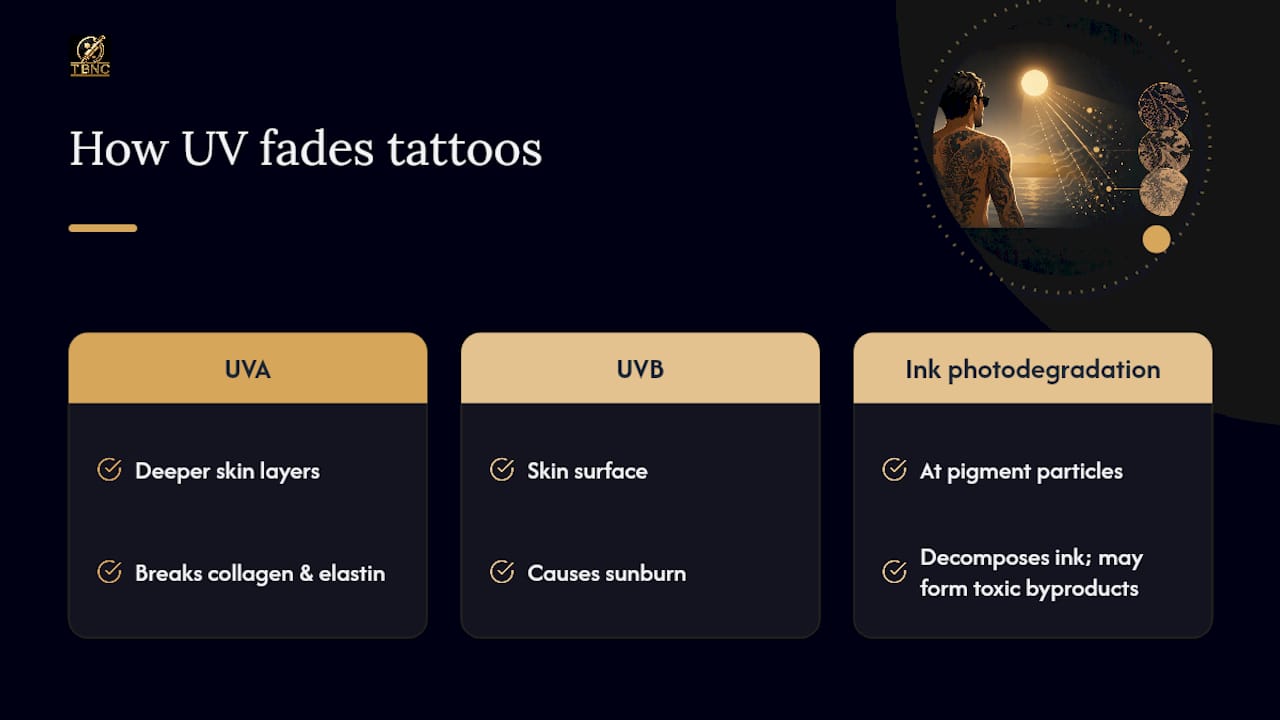
UV radiation attacks tattoos on two fronts. It breaks down the collagen and elastin fibers that hold pigment in place near the skin’s surface, and it triggers photochemical reactions that physically decompose certain ink particles. MD Anderson explains that chronic sun exposure accelerates this breakdown, which is why a tattoo left uncovered for years fades faster than one that’s been protected daily.
Not all pigments degrade the same way. A systematic review on tattoo pigment breakdown found that sunlight and laser exposure can photodegrade certain inks into byproducts, some of which raise toxicity concerns in lab testing.
Photodegradation from sunlight contributes to premature fading of colored tattoos and, in some pigments, produces breakdown compounds that researchers flag as potentially hazardous.
Broad-spectrum coverage matters because UVA and UVB damage skin differently: UVA penetrates deeper and drives collagen and pigment damage, while UVB causes the burn. Sunscreen won’t stop the natural aging of your ink entirely, but it slows the process considerably.
Mineral vs. Chemical Sunscreen: Which Protects Ink Better?
There’s no such thing as a dedicated “tattoo sunscreen” on the market. What matters is choosing a product that meets solid protective criteria and suits your skin’s sensitivity. The American Academy of Dermatology recommends broad-spectrum, water-resistant sunscreen with SPF 30 or higher for tattooed skin, full stop.
Where the real decision comes in is formula type:
- Mineral (physical) sunscreens use zinc oxide or titanium dioxide, sitting on top of skin and reflecting UV rays. They’re generally gentler on sensitive or newly healed skin.
- Chemical sunscreens absorb UV rays and convert them to heat. They tend to feel lighter but can sting on compromised or reactive skin.
Consumer health guidance on tattoo sun care leans toward mineral formulas for sensitive skin, and that guidance holds up especially well for large, colorful pieces where more surface area is exposed to product.
Pro Tip: If you’ve got sensitive skin, a big back piece, or heavily saturated color work, start with a mineral sunscreen and patch-test it on a small area first. Save the chemical formulas for skin that’s proven it can tolerate them.
How to Apply Sunscreen on a Tattoo the Right Way
Timing and coverage matter as much as the SPF number on the bottle.
- Apply sunscreen 15 to 30 minutes before you head outside, giving it time to bind to skin.
- Use a generous amount, roughly nickel to quarter sized for a forearm-sized tattoo, and rub it in gently rather than rubbing it in like lotion on unaffected skin.
- Reapply every two hours, and immediately after swimming or heavy sweating.
The AAD’s reapplication standard exists because sunscreen breaks down with sweat, water, and time, not because manufacturers want you buying more product.
- Skip fragranced sunscreens on skin that only recently finished healing.
- Don’t stack a heavy aftercare balm and a new sunscreen on the same day without knowing they play well together.
- For hard-to-reach spots like your upper back, ask someone to help or use a spray formula for coverage.
- If you’re driving with an arm or hand tattoo exposed to window light, sunscreen still applies. UVA passes through glass.
Protecting a Fresh Tattoo Without Sunscreen
If your tattoo isn’t healed yet, sunscreen isn’t your tool. Physical protection is. Keep new tattoos out of direct sun using loose, breathable clothing and shade whenever you’re outside.
- UV-blocking clothing or sleeves designed for sun protection
- Wide-brim hats for facial or scalp work
- Light, non-adhesive bandaging only if your artist specifically recommends it
MD Anderson’s dermatology team is blunt about why sunscreen is the wrong call on unhealed skin: it can trap bacteria against an open wound and cause irritation that slows healing.
Physical barriers protect fresh tattoos without introducing new products onto compromised skin, which is exactly what dermatologists recommend during the inflammatory phase.
Avoid tanning beds entirely during this window, and if a fresh tattoo does get sunburned, treat it as an aftercare emergency: cool compresses, gentle moisture, and a call to your artist or a dermatologist if blistering shows up.
Ingredients to Avoid and How to Patch-Test Sunscreen
Some sunscreen ingredients irritate tattooed skin more than others, especially fragrance, alcohol-based sprays, and certain preservatives known to trigger contact sensitivity. Avoid these on skin that’s newly healed or prone to reactions.
- Choose a small, inconspicuous area of tattooed skin, like the inner edge of the piece.
- Apply a small amount and wait 24 to 48 hours without washing the area.
- Check for redness, itching, or bumps before applying the sunscreen to the full tattoo.
If you have darker skin tones, a history of allergic contact dermatitis, or pigment-prone skin, patch-testing matters even more, since reactions can affect surrounding skin tone as well as the tattoo itself.
Stop use immediately, rinse the area, and contact a healthcare provider if you notice swelling, blistering, or spreading redness after applying any new sunscreen.
Building Sunscreen Into Your Daily Tattoo Aftercare Routine
Sun protection works best as a habit, not a once-in-a-while fix reserved for beach days. Public-health researchers point out that tattoo studios rarely give comprehensive sun-safety guidance alongside standard aftercare instructions, which leaves collectors to figure out the routine on their own.
- Apply sunscreen every morning to any exposed, healed tattoo, not just before beach trips.
- Moisturize first with a gentle, fragrance-free product, let it absorb, then layer sunscreen on top.
- Build in seasonal habits: reapply more aggressively during pool days, hikes, or vacations.
For daily moisturizing that plays well with a sunscreen routine, Tattoo Butter works as a lightweight layer that absorbs before sunscreen goes on. Heavier or drier areas may do better with Tattoo Aftercare Balm, applied and given a few minutes to soak in first.
Pro Tip: Apply moisturizer, wait five minutes, then apply sunscreen. Layering them back to back can cause pilling and leaves gaps in coverage.
A Practical Note on Prevention
Most healed tattoos do fine with a consistent sunscreen habit and a little patience. The mistakes that cause real damage almost always come from rushing sunscreen onto skin that hasn’t finished healing, or skipping it entirely once the excitement of a new piece wears off. If something feels off, a quick check with your artist or a dermatologist beats guessing.
Where TBNC Aftercare Products Fit Into Your Sun Routine
TBNC Tattoo built its aftercare line around the same principle dermatologists recommend: gentle, fragrance-conscious formulas that support healing skin instead of fighting it. For travel days when you need something compact for reapplication after swimming or sweating, the Tattoo Butter Travel Sticks (3pack) slide into a bag and moisturize on the go, sitting comfortably underneath sunscreen once you’re fully healed. For daily home use, Tattoo Butter works as your everyday base layer, while Tattoo Aftercare Balm handles drier or more stubborn areas that need extra reinforcement. Check each product page for the full ingredient list and usage guidance before adding it to your sunscreen routine.
Sources
- Caring for tattooed skin — American Academy of Dermatology
- How to protect tattoos from sun exposure | MD Anderson Cancer Center
- Aftercare instructions in the tattoo community: an opportunity to educate on sun protection and increase skin cancer awareness — PMC
- Current knowledge of the degradation products of tattoo pigments by sunlight, laser irradiation and metabolism: a systematic review — Journal of Exposure Science & Environmental Epidemiology (preview)
FAQ
What sunscreen can I put on a tattoo?
Any broad-spectrum, water-resistant sunscreen with SPF 30 or higher works, applied only once the tattoo is fully healed. Mineral formulas with zinc oxide tend to suit sensitive or recently healed skin best.
Is SPF 30 or SPF 50 better for tattoos?
SPF 30 meets the American Academy of Dermatology’s minimum recommendation for effective UVB protection. Either works well as long as you reapply every two hours.
Will sunscreen stop tattoo fading?
Sunscreen slows fading significantly by blocking the UV rays that degrade pigment and break down collagen, but it won’t stop the gradual, natural aging of ink entirely.
Is there a difference between regular sunscreen and tattoo sunscreen?
No dedicated “tattoo sunscreen” category exists. Any broad-spectrum, SPF 30+ sunscreen that suits your skin sensitivity, mineral or chemical, works on healed tattooed skin.


