

Tattoo Blowout Fix: When to Cover Up vs. Go Laser
Yes, a tattoo blowout can usually be improved. Mild-to-moderate cases respond well to touch-ups, cover-ups, or targeted laser fading. Severe migration into deep tissue is harder to fully reverse, but even those cases have options. The path you choose depends on how deep the ink traveled, where the tattoo sits on your body, and how long ago it was done.
Here’s what to do right now:
- Photograph it immediately. Natural light, same angle, every few days. You need a documented baseline to track whether the blur is healing-related or permanent.
- Keep it clean and protected. Gentle soap, lukewarm water, a thin layer of unscented moisturizer. No picking, no soaking, no direct sun.
- Contact your original artist within the first week. Send those photos. A good artist will tell you honestly whether what you’re seeing is normal healing or a true blowout.
- Wait before committing to any fix. Most tattoos need 4–8 weeks to fully heal. What looks like a blowout at day five may look very different at week six.
- If the blur persists past full healing, consult a laser specialist alongside your artist. Some cases benefit from targeted laser fading before any corrective ink goes in.
Table of Contents
- What causes a tattoo blowout, and which body areas are most at risk?
- Which correction method is right for your blowout?
- How do Q-switched and picosecond lasers treat blowout ink?
- How artists plan cover-ups and touch-ups for blowouts
- Aftercare for a healing tattoo or post-fix skin
- How to reduce your blowout risk before your next session
- Key Takeaways
- The gap between “fixed” and “perfect”
- Comfort and healing products for corrective tattoo work
- Further reading and clinical sources
- FAQ
What causes a tattoo blowout, and which body areas are most at risk?
A tattoo blowout happens when ink is deposited below the dermis—the skin layer where tattoo pigment is supposed to live—and into the subcutaneous fat underneath. Fat tissue has no structure to hold ink in place, so the pigment spreads outward unpredictably, creating that characteristic blurred halo or shadow around the tattoo’s edges.
The anatomy matters here. The dermis anchors ink through a network of collagen fibers. Once ink slips past that layer into the hypodermis, it diffuses through fatty tissue with no natural boundary to contain it. That’s why blowouts blur and can be difficult to fully reverse — you’re not dealing with misplaced ink in a stable environment, but ink in tissue that actively resists containment.
The primary cause is technique. A needle set too deep, a hand moving too slowly, or an artist overworking a single area can all push ink past the dermis. Skin thickness plays a major role too. Areas where the skin sits directly over bone or where it’s naturally thin give artists very little margin for error.
High-risk placements include the wrists, inner wrists, hands and fingers, feet and ankles, ribs, inner arms, and behind the ears. These spots combine thin skin with frequent movement, which means the skin shifts during tattooing and makes precise depth control harder. Fine-line and small-detail work in these areas carries the highest blowout risk of any style.
Which correction method is right for your blowout?
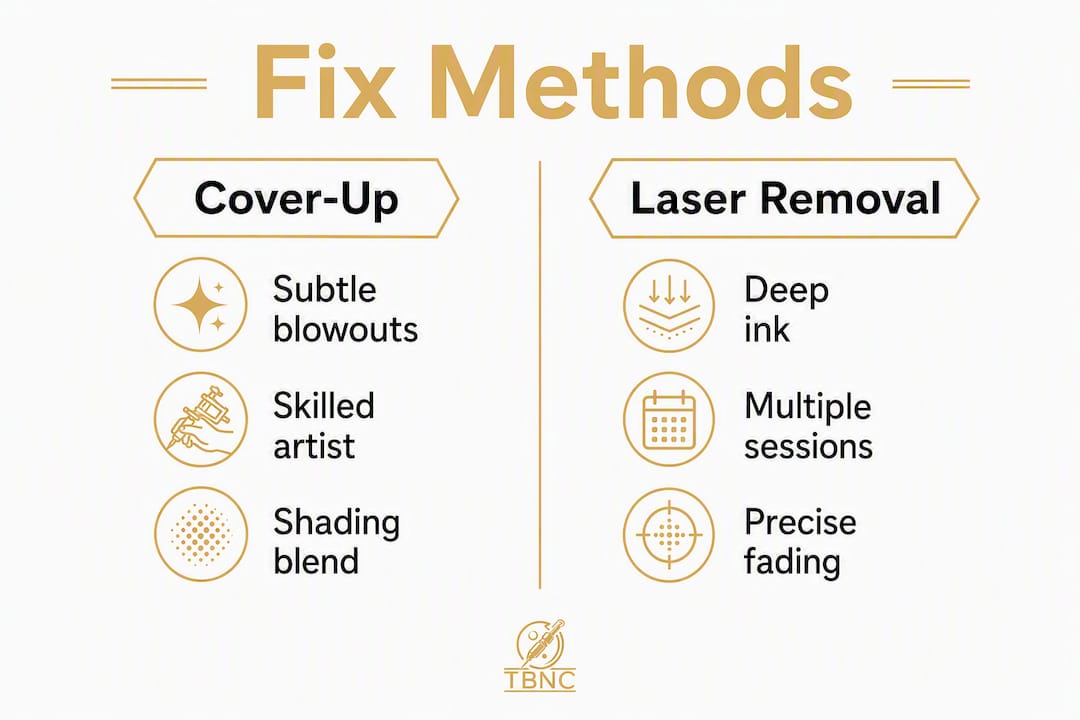
Three practical correction paths exist: touch-up or detailing work, a cover-up tattoo, and laser fading or removal. Surgical excision is a fourth option, reserved for small tattoos in locations where skin can be cleanly removed and sutured. Each approach solves the problem differently.
| Method | Best for | How it fixes the problem | Typical timeline | Avg. U.S. cost range | Risks and downtime |
|---|---|---|---|---|---|
| Touch-up / detailing | Mild blowouts with minor edge blur | Redefines lines, adds shading to blend halo | 1 session after full healing | — | Minimal; re-healing period |
| Cover-up tattoo | Moderate blowouts; client wants new design | Camouflages with larger, darker composition | 1–2 sessions | — | Limits future design choices |
| Laser fading (partial) | Moderate-to-severe; client wants to keep design | Fragments migrated ink, improves edges | 1–6+ sessions over months | — | Pigment change, blistering, short downtime |
| Full laser removal | Severe blowouts; client wants clean slate | Removes all ink over multiple sessions | 1–3 sessions | — | Scarring risk, longer timeline |
| Surgical excision | Small tattoos in excisable locations | Physical removal of skin | Single procedure | — | Scarring, sutures, recovery |
Realistic expectations matter. For most blowouts, “fixed” means noticeably improved, not restored to the original crisp design. Targeted laser correction can selectively treat migrated ink while leaving the main design intact, which is often the most practical outcome for collectors who love the piece but hate the halo.
Touch-ups work best when the blowout is subtle and the original artist is skilled enough to blend the edges with shading or thicker linework. Cover-ups require a larger, darker design to fully mask the spread, which means you’re committing to a different tattoo. Laser fading before a cover-up is often the smartest sequence for moderate blowouts: a few sessions to lighten the migrated ink, then a cover-up with far more design flexibility.
How do Q-switched and picosecond lasers treat blowout ink?
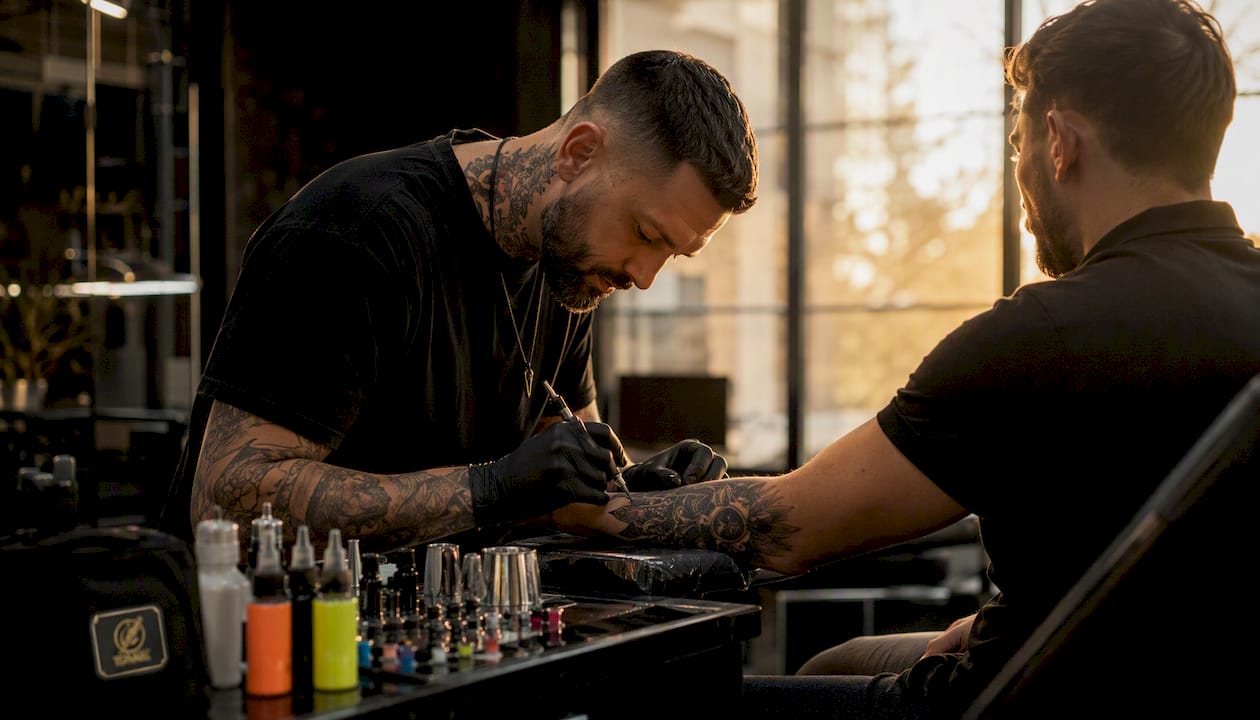
Laser removal works by delivering concentrated light energy in extremely short pulses. That energy shatters tattoo pigment into particles small enough for the body’s immune system to clear. The two laser classes most relevant to blowout correction are Q-switched lasers and picosecond lasers.
Q-switched lasers deliver nanosecond-duration pulses and have decades of clinical use behind them. Peer-reviewed literature documents their mechanisms and outcomes for tattoo pigment removal across a range of ink colors and skin types. Picosecond lasers deliver pulses roughly 100 times shorter, which fragments ink more efficiently and often with less thermal damage to surrounding tissue. For blowouts specifically, the advantage of picosecond technology is precision: the shorter pulse duration allows more selective targeting of diffuse, scattered pigment.
For a localized blowout, improvement often appears after 1–3 sessions. Dense or deeply migrated ink may require more. Sessions are typically spaced 6–8 weeks apart to allow the body to clear fragmented pigment between treatments.
| Laser type | Pulse duration | Best for | Typical sessions for blowout fade |
|---|---|---|---|
| Q-switched Nd:YAG | Nanoseconds | Dark inks, deeper pigment | 3–6+ sessions |
| Picosecond (e.g., PicoSure, PicoWay) | Picoseconds | Scattered/diffuse pigment, stubborn colors | 1–4 sessions for localized areas |
Side effects to expect: redness, swelling, and blistering in the treated area for several days. Hypopigmentation (lightening of the surrounding skin) and hyperpigmentation are real risks, particularly for darker skin tones. Clinical studies on laser interactions with skin support staged, conservative treatment plans rather than aggressive single sessions, especially for clients with Fitzpatrick skin types IV–VI.
When selecting a laser provider, look for these qualifications:
- Board-certified dermatologist or licensed laser technician with documented tattoo removal experience
- Before-and-after photos of blowout-specific cases, not just full removal
- Willingness to perform a conservative test spot before full treatment
- Clear explanation of which laser they use and why it suits your ink color and skin tone
- Written aftercare instructions and a follow-up protocol
How artists plan cover-ups and touch-ups for blowouts
A skilled tattoo artist doesn’t just slap a bigger design over a blowout. They plan around the spread. The migrated ink becomes part of the design problem they need to solve, and the best artists treat it like a puzzle rather than an obstacle.
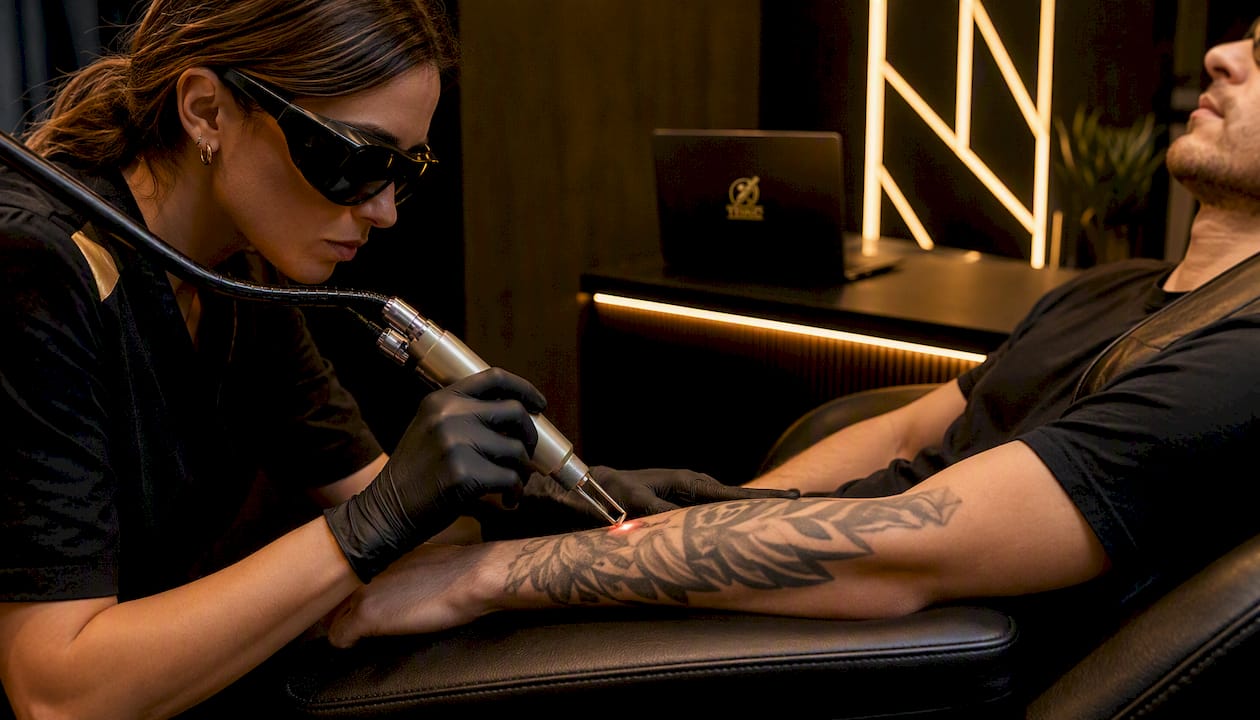
Common design strategies include thickening existing linework to absorb the blur, building a shading gradient that transitions naturally from the halo into the new composition, using a larger overall design that gives the blowout room to disappear within darker areas, and incorporating negative space strategically so the eye is drawn away from the affected edges. For thin-skin areas like wrists or ankles, an experienced artist may recommend a bolder style than the original to reduce the risk of the correction blowing out again.
Before committing to a cover-up, ask these questions:
- Can I see healed photos of your cover-up work, specifically on blowouts or blurred tattoos?
- Will you sketch the proposed design over a photo of my tattoo before we book?
- How much of the original tattoo will still be visible under the new design?
- Do you recommend laser fading first, given the severity of my blowout?
Selecting an artist based on healed work, not fresh photos, is the strongest indicator of skill. Fresh tattoos always look sharp. Healed work shows you how the artist’s lines hold up over time and whether their shading ages cleanly.
One approach that sounds tempting but consistently fails: tattooing skin-toned pigment over the blowout to camouflage it. Skin-tone inks lack the opacity to cover dark migrated pigment, they age unpredictably as the skin changes, and they make future laser removal significantly more complicated. Any artist who suggests this as a primary fix is worth a second opinion.
A cover-up is unlikely to succeed without laser prep when the blowout is large, the migrated ink is dark and spread widely, or the original tattoo is already dense. In those cases, 2–4 laser sessions to lighten the area first will dramatically expand your cover-up design options.
Aftercare for a healing tattoo or post-fix skin
Whether you’re healing a fresh tattoo that blew out, recovering from a laser session, or nursing a touch-up, the aftercare principles are consistent: keep it clean, keep it moisturized, and keep it protected from the sun.
For a fresh or corrected tattoo:
- Wash gently with a fragrance-free tattoo foaming soap twice daily using lukewarm water
- Pat dry with a clean paper towel, never a cloth towel that may harbor bacteria
- Apply a thin layer of tattoo aftercare balm or unscented lotion 2–3 times daily
- Avoid submerging the area in water for at least 2–3 weeks
- Apply SPF 30+ sunscreen once the skin has closed, and keep it up long-term to prevent fading
Post-laser care differs in one key way: the skin is more vulnerable to infection and pigment disruption. Keep the area out of the sun entirely until fully healed, and avoid any active skincare ingredients (retinoids, AHAs, BHAs) on the treated area. Always follow your laser provider’s specific instructions before adding any topical product.
Healing is where results are won or lost. A well-executed cover-up or laser session can be undermined by poor aftercare. Fragrance-free, dermatologist-approved products reduce the risk of contact dermatitis and irritation that can distort how the skin heals and how the final result looks.
Watch for these signs that something needs medical attention: increasing redness or warmth after day 3, pus or unusual discharge, fever, or skin that feels hot to the touch. These suggest infection, not normal healing, and require a doctor’s assessment.
Pro Tip: Choose fragrance-free, dermatologist-approved aftercare products for every stage of healing. Fragrances are among the most common causes of contact dermatitis on healing tattoo skin, and even a mild reaction can affect how the final result looks.
TBNC Tattoo’s aftercare line, including its soothing gel and unscented lotion, is formulated specifically for tattooed skin and fits directly into this routine. For the initial comfort of a corrective session, TBNC’s lidocaine numbing creams can reduce the intensity of the procedure itself.
How to reduce your blowout risk before your next session
Prevention is straightforward once you understand what causes blowouts. Most of it comes down to artist selection and placement decisions made before the needle touches your skin.
Pre-appointment checklist:
- Review healed linework photos, not just fresh tattoo photos, from the artist’s portfolio
- Avoid fine-line or micro-detail styles on high-risk placements (wrists, hands, feet, ribs) unless the artist has documented healed results in those exact areas
- Hydrate your skin consistently in the weeks before your appointment; well-hydrated skin holds ink more predictably
- Avoid blood thinners (including alcohol, aspirin, and fish oil) in the 24–48 hours before your session if your artist recommends it
- For sensitive or high-pain areas, use a quality numbing cream for high-pain placements to reduce flinching and involuntary movement that can affect needle depth
During the session, you have more influence than most people realize. Ask your artist about their needle depth approach for the placement you’ve chosen. Request that they work in stages on large or complex pieces rather than overworking one area. If the skin looks irritated or the artist seems to be pushing through resistance, it’s reasonable to pause and reassess. A confident, experienced artist will welcome that conversation.
Red flags to watch for: an artist who dismisses questions about technique, who doesn’t adjust their approach for thin-skin areas, or who can’t show you healed examples of similar work. Rolling the dice on an artist’s fresh photos alone is how most blowouts happen in the first place.
Key Takeaways
A tattoo blowout can be improved in most cases, with the right fix depending on severity: wait until fully healed, then choose touch-up, cover-up, or laser fading based on how far the ink migrated.
| Point | Details |
|---|---|
| Wait before acting | Most tattoos need 4–8 weeks to fully heal before a true blowout can be confirmed. |
| Match fix to severity | Mild blowouts suit touch-ups; moderate cases often need cover-ups or laser fading; severe migration may require full removal. |
| Laser options | Q-switched and picosecond lasers can fade localized blowouts, often with visible improvement after 1–3 sessions for targeted areas. |
| Prevention starts with artist selection | Reviewing healed linework photos before booking is the single most effective way to avoid blowouts. |
| TBNC Tattoo aftercare | TBNC’s dermatologist-approved aftercare products and lidocaine numbing creams support comfort during corrective sessions and protect healing skin afterward. |
The gap between “fixed” and “perfect”
Here’s the honest editorial take: most people who come to a blowout fix expecting to get their original tattoo back will be disappointed. That’s not a failure of the process. It’s a misunderstanding of what correction actually delivers.
What “good” improvement looks like in practice is cleaner edges, a reduced halo, and a tattoo that reads as intentional rather than damaged. It rarely means the crisp, fresh-off-the-needle precision of the original design. The ink that migrated into subcutaneous fat has already spread. Laser can fragment it and the body can clear it, but that takes time and multiple sessions. A cover-up can hide it, but it changes the design. Neither option is a reset button.
The practitioners worth trusting are the ones who tell you this upfront. Be cautious of anyone who promises complete correction in a single session, whether that’s a laser technician or a tattoo artist. Staged, conservative treatment consistently outperforms aggressive single-session approaches, and the clinical evidence supports that position.
One caution that doesn’t get enough attention: don’t rush a cover-up before the skin has fully healed. Tattooing over skin that’s still in the healing phase risks compounding the original problem. The same applies to laser work done too soon after the initial tattoo. Patience here isn’t passive; it’s the most strategic move you can make.
Comfort and healing products for corrective tattoo work
Corrective sessions, whether a cover-up, touch-up, or laser treatment, tend to be more intense than the original tattoo. The skin is already sensitized, the work is often detailed, and the stakes feel higher. That’s where preparation makes a real difference.

TBNC Tattoo’s lidocaine numbing creams are trusted by over 3,250 studios worldwide and used in over one million sessions. They’re formulated for the kind of extended, precise work that corrective tattooing demands, giving you the comfort to sit through a full session without flinching. For post-session recovery, the TBNC tattoo aftercare bundle covers every stage of healing with dermatologist-approved, fragrance-free products designed specifically for tattooed skin.
Check with your laser provider before applying any topical product to a post-laser treatment area, as protocols vary by clinic and skin type. For cover-up and touch-up aftercare, TBNC’s full aftercare collection fits directly into the routine outlined in this guide.
Further reading and clinical sources
A note on sources: The clinical and industry references below represent the strongest available evidence on laser tattoo removal, pigment behavior, and wound healing. For medical questions specific to your skin type or health history, consult a board-certified dermatologist or licensed laser specialist directly.
- Tattoo Blowout: Appearance, Treatments, and More
- What to Do If Tattoo Blowout Happens: Causes, Fixes, and Prevention
- Tattoo Blowout: What It Is and What You Can Do About It
- Can Laser Tattoo Removal Fix Tattoo Blowouts, Blurry Lines, or Small Tattoo Mistakes?
- Three ways to get a tattoo blowout fixed
- Tattoo blowout — CNC Tattoo
- pubmed.ncbi.nlm.nih.gov
- ncbi.nlm.nih.gov
FAQ
Can tattoo blowouts be fixed?
Yes, most blowouts can be meaningfully improved through touch-ups, cover-up tattoos, or laser fading, though full restoration to the original crispness is rarely guaranteed. The right approach depends on how deeply the ink migrated and where the tattoo is located.
Are tattoo blowouts the artist’s fault?
Usually, yes. Blowouts are most often caused by depositing ink too deep into the skin, which is a technique issue. Placement on thin-skin areas increases the risk, but an experienced artist accounts for that by adjusting their approach.
Can you get rid of a tattoo blowout completely?
Partial or full removal is possible with multiple laser sessions using Q-switched or picosecond lasers, and localized blowouts often show visible improvement after just 1–3 targeted sessions. Complete erasure depends on ink density, color, and how far the pigment migrated.
Can tattoo blowouts disappear on their own?
A true blowout, where ink has migrated into subcutaneous fat, does not resolve on its own. What can resolve is a healing blur caused by swelling or trauma in the first few weeks, which is why waiting 4–8 weeks before drawing conclusions is the standard guidance.


