

Tattoo Keloid Risk: What Keloid-Prone Skin Needs to Know
Yes, tattoos can cause keloids. Any needle-based skin trauma can trigger abnormal scarring in people who are predisposed, and a tattoo session delivers hundreds of thousands of micro-injuries in a single sitting. If you have a personal or family history of keloids, your tattoo keloid risk is meaningfully higher than the general population’s. Here’s what to do right now:
- Avoid elective tattooing over or near any existing keloid until you’ve had a dermatologist consultation.
- Book a dermatology consult before your appointment if you have a prior keloid or a first-degree relative who does. Mayo Clinic identifies personal and family history as the strongest predictors of keloid formation.
- Seek early treatment the moment you notice firm, progressive thickening at a healed tattoo site. The window for effective noninvasive management is narrow, and waiting closes it fast.
According to StatPearls on NCBI, keloids can rise 0.5 cm or more above the surrounding skin. That’s not a subtle bump you’ll miss — but catching the early signs before that stage is what separates a manageable situation from a difficult one.
Table of Contents
- What exactly is a keloid?
- How do keloids differ from hypertrophic scars?
- Who is at higher risk of developing keloids?
- How to minimize keloid risk before, during, and after a tattoo
- What are your treatment options if a keloid forms?
- Can you tattoo over or near an existing keloid?
- What does the clinical literature say about tattoos and keloids?
- Key Takeaways
- The real decision most keloid-prone collectors get wrong
- TBNC Tattoo aftercare products for cautious collectors
- Useful sources
- FAQ
What exactly is a keloid?
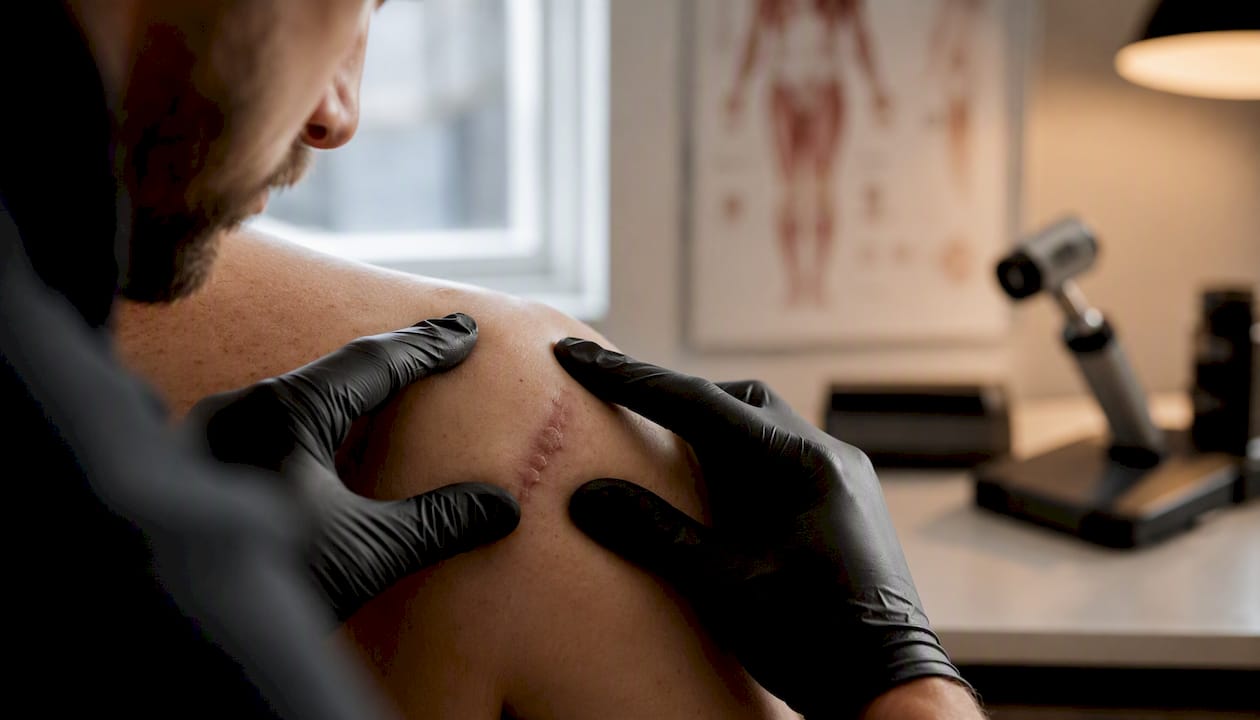
A keloid is not just a thick scar. It’s the result of an abnormal wound-healing response in which the body overproduces collagen, creating a fibrous growth that extends beyond the original wound’s borders. Unlike a normal scar that gradually flattens, a keloid keeps growing. It doesn’t know when to stop.
Visually, keloids are:
- Raised and firm, often with a shiny, smooth surface
- Hyperpigmented, typically darker than the surrounding skin
- Itchy or painful, especially during active growth phases
- Irregular in shape, spreading beyond the original injury site
- Potentially elevated 0.5 cm or more above the epidermis
On a tattooed area, a keloid often appears as a raised, rounded ridge that grows outward from the tattoo line. The ink may still be visible underneath, but the texture becomes distinctly abnormal. If a scar is still growing several months after your tattoo healed, that’s a clinical signal worth acting on, not monitoring from home.
How do keloids differ from hypertrophic scars?
The distinction matters clinically because the two conditions have different prognoses, different recurrence rates after treatment, and different management strategies.
The core diagnostic difference: a hypertrophic scar stays within the original wound boundaries. A keloid grows beyond them. That single feature changes everything about how a clinician approaches treatment.
| Feature | Hypertrophic Scar | Keloid |
|---|---|---|
| Boundary | Stays within wound margins | Extends beyond wound margins |
| Onset | Weeks after injury | Months after injury, sometimes years |
| Growth pattern | Stabilizes, may regress | Continues to grow |
| Recurrence after excision | Lower | High |
| Symptoms | Mild tightness | Often itchy, tender, or painful |
| Common sites | Any wound site | Chest, shoulders, earlobes, upper back |
StatPearls’ review of hypertrophic scarring and keloids confirms that keloids frequently continue proliferating beyond wound margins and carry a high recurrence rate after surgical excision. That recurrence risk is the reason dermatologists rarely recommend excision alone. A hypertrophic scar on a tattoo is frustrating; a keloid is a longer-term management challenge.
Who is at higher risk of developing keloids?
The strongest predictors are personal history of keloids and darker skin tone, followed closely by age and body site. If you check more than one of these boxes, your risk profile shifts from theoretical to real.
Primary risk factors:
- Darker skin tones — (Brown or Black skin) — Mayo Clinic notes this demographic carries significantly elevated risk
Pro Tip: Before booking a tattoo, run through these four questions: (1) Have I ever had a keloid? (2) Has a parent or sibling had one? (3) Is my chosen placement on a high-tension site like the chest or shoulder? (4) Am I currently dealing with any active inflammation or skin condition? If you answer yes to two or more, a dermatology consult isn’t optional — it’s the responsible first step.
How to minimize keloid risk before, during, and after a tattoo
The most effective prevention is avoiding elective skin trauma entirely if you’re high-risk. For everyone else, strict technique and aftercare are the best tools available.
Before your session:
- Complete a dermatology consultation and get written clearance if you have any keloid history.
- Choose a low-tension placement site away from the chest, shoulders, and upper back.
- Request a patch test at least three months before your full session.
- Avoid tattooing during periods of systemic inflammation, illness, or active skin conditions.
During your session:
- Confirm single-use, sterile needles and equipment before the artist begins.
- Ask the artist to work at appropriate needle depth — not deeper than necessary for pigment placement.
- Use a dermatologist-approved numbing cream to reduce procedural stress on the skin; less pain response can mean less acute inflammation.
After your session:
- Cleanse gently with a fragrance-free, antibacterial wash within the first few hours.
- Apply an unscented moisturizer to keep the wound hydrated without irritating it. Mayo Clinic’s tattoo aftercare guidance specifically recommends unscented products to reduce irritation during healing.
- Once the surface has closed, consider silicone sheeting or gel over the tattooed area. StatPearls cites pressure therapy at 15–45 mm Hg for more than 23 hours per day for at least six months as a clinically supported prevention measure.
- Avoid sun exposure on the healing tattoo, and never pick or scratch the peeling skin.
- Keep the area moisturized with a tattoo aftercare lotion that’s unscented and formulated for sensitive, healing skin.
Pro Tip: Contact a dermatologist immediately if you notice a firm nodule forming at the tattoo site, progressive growth beyond the tattoo border, or persistent itching and pain that extends well past the normal two-to-three-week healing window. Early intervention is the single biggest factor in treatment success.
What are your treatment options if a keloid forms?
No single treatment reliably cures a keloid. The best outcomes come from combination approaches started early, and recurrence after any single-modality treatment is common. That’s the clinical reality, and understanding it helps set realistic expectations.
| Treatment | How It Works | Pros | Cons / Recurrence Notes |
|---|---|---|---|
| Intralesional corticosteroids | Injected directly into the keloid to suppress collagen production | First-line therapy; well-studied | Requires repeat sessions; may cause skin atrophy |
| Cryotherapy | Freezes keloid tissue to reduce bulk | Can be combined with injections | May lighten surrounding skin; multiple sessions needed |
| Silicone sheeting / gel | Occlusive barrier that hydrates and compresses scar tissue | Noninvasive; supported by clinical evidence | Requires months of consistent daily use |
| Pressure garments | Sustained compression at 15–45 mm Hg | Effective adjunct post-excision | Demanding adherence; >23 hours/day for 6+ months |
| Laser therapy | Targets vascularity and pigment within the keloid | Can reduce redness and bulk | May blur or fade tattoo ink; not curative alone |
| Surgical excision + adjuvant injections | Removes keloid tissue, followed by steroid injections | Addresses large keloids | High recurrence if excision is used alone |
| Corticosteroid tape | Topical steroid delivery via adhesive | Convenient for maintenance | Lower potency than intralesional; limited for large keloids |
Pro Tip: Combination therapy consistently outperforms single-modality treatment. Intralesional steroid injections before and after surgical excision, for example, significantly reduce recurrence compared to excision alone. If a dermatologist recommends surgery without any adjuvant plan, ask specifically about what follows the procedure.
A practical note on your tattoo ink: laser therapy may blur or fade pigment in the treated area, and more advanced options like PRP therapy: a breakthrough in treating chronic wounds may support healing of difficult scars. Surgical excision removes the ink along with the tissue. Cryotherapy and steroid injections are less likely to destroy pigment but can alter the skin’s texture and tone. Discuss ink preservation with your dermatologist if that matters to you.
Can you tattoo over or near an existing keloid?
Generally, no — not if the keloid is active, recently formed, or less than fully stable. Tattooing over an active keloid re-injures already dysregulated tissue and can cause the keloid to grow larger, spread, or become more symptomatic.
If you’re considering it, Healthline’s clinical guidance on keloid tattooing recommends waiting at least one year after a keloid fully stabilizes before attempting any tattooing over it. Even then, the decision requires both dermatologist sign-off and an artist with documented experience in scar tattooing.
Decision criteria before proceeding:
- Documented stability for at least 12 months with no growth, color change, or new symptoms
- Written dermatologist clearance after a physical examination
- A small test patch in a low-visibility area, monitored for three months
- Conservative design that avoids heavy shading or dense linework directly over the scar
- Clear expectation that pigment uptake over scar tissue is unpredictable and results may be uneven
Pro Tip: If the goal is concealing a keloid rather than decorating it, high-quality skin-tone cosmetics or medical-grade camouflage products are a lower-risk option while you wait for full stabilization. Re-inking before the scar is truly stable is one of the most common reasons keloids worsen after a tattoo attempt.
What does the clinical literature say about tattoos and keloids?
Clinical consensus is consistent: primary prevention and early dermatology referral are the most effective strategies. Treatments help, but recurrence is common across all modalities, and no approach guarantees permanent resolution.
Key evidence points from peer-reviewed literature:
- Genetic predisposition and darker skin tone are the most consistently documented risk factors across multiple clinical reviews
- High-tension body sites (chest, shoulders, upper back) carry disproportionate risk regardless of skin tone
- Inflammation is the primary biological driver of keloid formation, making anti-inflammatory aftercare a clinically rational prevention strategy
- Silicone and pressure therapy are the most evidence-supported noninvasive prevention and adjunct treatment options
- Tattoo-related infections and inflammatory reactions increase downstream scarring risk, reinforcing the importance of sterile technique
- Waiting at least 12 months before tattooing over a stabilized scar is the standard clinical recommendation
| Clinical Parameter | Sourced Detail |
|---|---|
| Keloid elevation above epidermis | ≥0.5 cm (StatPearls) |
| Pressure therapy range | 15–45 mm Hg, >23 hrs/day, ≥6 months (StatPearls) |
| Peak age risk group | 20–30 years (Mayo Clinic) |
| Minimum wait before scar tattooing | 12 months post-stabilization (Healthline) |
| Recurrence after excision alone | High (StatPearls hypertrophic/keloid review) |
Key Takeaways
People with keloid-prone skin can reduce tattoo keloid risk significantly by consulting a dermatologist before booking, choosing low-tension placement sites, and committing to strict anti-inflammatory aftercare from day one.
| Point | Details |
|---|---|
| Consult before you commit | A dermatology consult before tattooing is non-negotiable if you have any personal or family history of keloids. |
| Site selection matters | Avoid the chest, upper back, and shoulders — high wound tension at these sites raises keloid risk regardless of skin tone. |
| Catch it early | Keloids typically emerge within three months; firm, progressive thickening at that stage needs a dermatologist, not more waiting. |
| Silicone and pressure work | Clinical evidence supports silicone sheeting and pressure therapy (15–45 mm Hg, >23 hrs/day, ≥6 months) as the strongest noninvasive prevention tools. |
| TBNC Tattoo aftercare | TBNC Tattoo’s unscented aftercare lotion and soothing gel support gentle, inflammation-minimizing healing for cautious collectors. |
The real decision most keloid-prone collectors get wrong
There’s a gap between what people ask about keloids and what actually drives outcomes. Most of the questions are about treatment: What can I do if one forms? Which injection works best? Can a laser fix it? Those are the wrong questions to lead with.
The clinical evidence is clear that prevention and timing are where the leverage is. Keloids that are caught in the first few weeks of abnormal growth respond far better to noninvasive management than keloids that have been growing for a year. And keloids that never form because someone chose a lower-tension placement site, used proper aftercare, and avoided tattooing during a period of systemic inflammation — those are the best outcomes of all.
What gets underestimated is the psychological weight of a keloid on a visible tattoo. The piece you got to express something meaningful becomes a source of self-consciousness. That’s a real cost, and it’s one that a pre-tattoo dermatology consult and a thoughtful placement decision can often prevent entirely.
The other thing worth saying plainly: not every raised area after a tattoo is a keloid. Hypertrophic scars are more common, less aggressive, and often resolve with conservative management. Panicking over normal healing firmness at six weeks is unnecessary. But dismissing progressive, expanding firmness at four months as “still healing” is the mistake that lets a manageable situation become a difficult one.
Know the difference. Act on the right signal at the right time.
TBNC Tattoo aftercare products for cautious collectors
Gentle, dermatologist-aligned aftercare can reduce inflammation and irritation during healing, but it does not prevent keloids by itself. For collectors who are proceeding thoughtfully with a tattoo despite some risk factors, the right products at the right stage make a real difference.
TBNC Tattoo’s line covers every phase of the process. Before and during your session, the Tattoo Numbing & Aftercare Bundle pairs lidocaine-based numbing cream with aftercare essentials, reducing procedural stress on the skin from the first needle pass. For immediate post-session care, the Tattoo Soothing Gel delivers cooling, anti-irritation relief that targets the acute inflammation phase — the exact window where keloid-prone skin needs the most support. Through the healing weeks, the Tattoo Aftercare Lotion (Unscented) keeps the wound hydrated without fragrance-based irritants, and the Tattoo Aftercare Balm provides an occlusive layer for collectors who need extra moisture control.

For keloid treatment decisions, consult a board-certified dermatologist. TBNC Tattoo products support healthy healing — they are adjuncts, not medical treatments. Browse the full aftercare collection and choose the products that match your stage of care.
This article provides general information, not medical advice. Confirm your personal risk and any treatment decisions with a qualified dermatologist.
Useful sources
- Keloid(Archived) - StatPearls - NCBI Bookshelf
- Keloid scar - Symptoms and causes | Mayo Clinic
- Hypertrophic Scarring Keloids - StatPearls - NCBI Bookshelf
- Tattoo-Related Skin Reactions: Clinical Complications, Emerging Trends, and Management Strategies - PMC
- Keloid Tattoo: When Scars Form, Tattooing Over Keloids, More | Healthline
- Article on inflammation and keloid formation (ScienceDirect)
- Tattoos: Understand risks and precautions | Mayo Clinic
FAQ
How likely is it to get a keloid from a tattoo?
For people without a predisposition, the risk is low. For those with a personal or family history of keloids, the risk is significantly higher, particularly on high-tension sites like the chest and shoulders.
How do I know if I’m prone to keloids?
The clearest indicators are a prior keloid of your own or a first-degree relative who has had one. Mayo Clinic also identifies darker skin tones and age 20–30 as elevated-risk factors.
Do keloids ever fully go away on their own?
Keloids do not self-resolve the way normal scars do. They may stabilize and stop growing, but they rarely flatten without treatment, and recurrence after treatment is common without adjuvant therapy.
How do you avoid a keloid from a tattoo?
Choose a low-tension placement site, confirm sterile technique with your artist, and follow strict anti-inflammatory aftercare from day one, including unscented moisturizers and, once the surface closes, silicone sheeting. A pre-tattoo dermatology consult is the most protective step for anyone with a keloid history.
Can you tattoo over an existing keloid?
Only after the keloid has been fully stable for at least 12 months and a dermatologist has cleared you. Healthline recommends this minimum wait period, and even then, a small test patch and an experienced scar-tattoo artist are required.


