

4% Lidocaine and a 5 mg/kg Check: Tattoo Numbing Safety for Clients
Topical numbing products are safe for tattoo sessions only when they stay within FDA-approved OTC strengths and skip the shortcuts that turn a cream into a hazard. The single rule that matters most: never exceed 4% lidocaine, and never apply numbing product to broken skin or seal it under heavy plastic wrap. Everything else in tattoo numbing safety builds on that one line, backed by FDA advisories and the labeling standards brands like TBNC Tattoo follow.
TL;DR:
- Applying topical lidocaine above 4% or using occlusive plastic wrap significantly increases absorption, raising the risk of systemic toxicity and serious health emergencies.
- Only use OTC numbing products at or below 4% lidocaine, avoid applying on broken or irritated skin, and never cover the area with tight plastic unless explicitly permitted by the label.
- Proper dosing based on body weight and surface area, along with following timing instructions, is essential to prevent toxicity during tattoo sessions.
- Patch testing at least a week prior to the procedure can identify potential allergic reactions and prevent complications during tattooing.
- Repeated use or exceeding recommended strengths over time can lead to skin damage and long-term irritation, but occasional correct application poses minimal risks.
Table of Contents
- What the FDA and Clinicians Warn About
- How Topical Numbing Actually Works
- Your Pre-Session Safety Checklist
- Recognizing Toxicity and What to Do Immediately
- What Backs TBNC Tattoo’s Safety Claims
- Could You Be Allergic? Why Patch Testing Comes First
- Does Repeated Numbing Use Affect Your Skin Long Term?
- Storing Numbing Products So They Stay Effective and Safe
- What Most Guides Get Wrong About Numbing Safety
- Numbing Products Built Around These Same Rules
- Sources
- FAQ
What the FDA and Clinicians Warn About
The FDA has issued repeated advisories telling consumers to avoid OTC topical pain-relief products above 4% lidocaine, and warning letters from 2024 to 2025 flagged specific products sold well above that threshold. The agency’s concern isn’t theoretical. Misuse of high-concentration lidocaine has been tied to seizures, irregular heartbeat, and breathing difficulty severe enough to require emergency care.
The risk climbs fast once lidocaine crosses into the bloodstream in meaningful amounts. Early central nervous system symptoms tend to show up once plasma concentration passes roughly 5 micrograms per milliliter, and cardiovascular collapse becomes a real danger somewhere above 10 to 15 micrograms per milliliter. That’s not a wide safety margin, especially when someone applies an unregulated product over a large area and wraps it in plastic to boost the effect.
Three factors push absorption into dangerous territory:
- Concentration above 4%, which is the OTC ceiling the FDA has set for a reason.
- Occlusion, meaning plastic wrap or tight bandaging that traps the product against skin and multiplies uptake.
- Broken or irritated skin, which removes the barrier that normally slows absorption to a manageable rate.
Unapproved high-strength products are the common thread in nearly every serious incident the FDA has tracked. Products marketed as “extra strength” or “maximum numbing” outside the 4% limit are exactly what the agency’s warnings target, and they’re the products most likely to lack clear dosing instructions altogether.
How Topical Numbing Actually Works
Lidocaine, prilocaine, and tetracaine all work the same basic way: they block sodium channels in nerve endings, which stops pain signals from reaching the brain. The differences matter more than most people assume. Prilocaine carries a distinct risk of methemoglobinemia, a blood disorder that reduces oxygen delivery, particularly in infants and people with certain enzyme deficiencies. Tetracaine is more potent by weight but also more likely to irritate skin.
Absorption scales with three variables: how concentrated the product is, how much surface area it covers, and whether it’s occluded. A dose-by-weight framework commonly used in professional practice caps topical lidocaine at 5 mg per kilogram of body weight on intact skin. For a 70-kilogram adult, that ceiling works out to 350 mg total, which is a useful anchor before applying anything to skin that’s about to be tattooed for hours.
| Agent | Common use | Special risk |
|---|---|---|
| Lidocaine | Most OTC numbing creams and gels | Systemic toxicity above 4% or with occlusion |
| Prilocaine | Some combination anesthetic blends | Methemoglobinemia, especially in sensitive individuals |
| Tetracaine | Sprays and some professional-grade products | Higher potency raises irritation and absorption risk |
Comparing lidocaine, prilocaine, and tetracaine side by side makes it clear why concentration and application method matter more than which active ingredient sits on the label.
Your Pre-Session Safety Checklist
Getting numbing right is less about finding the strongest product and more about following a short list of rules that keep absorption predictable. Here’s the sequence that actually protects you:
- Choose an OTC product at or below 4% lidocaine. Anything higher requires a prescription and medical supervision for good reason.
- Never apply to broken, recently lasered, or freshly shaved irritated skin. Compromised skin absorbs numbing agents far faster than intact skin.
- Avoid prolonged occlusion unless the product label explicitly allows it, and consider using appropriate samolepilni materiali like adhesive materials to secure dressings safely. Plastic wrap left on too long can push absorption well beyond what the label anticipates.
- Limit the treated area to what the label recommends, not the size of the tattoo you’re planning.
- Follow the label’s timing instructions exactly, including how long before the session to apply and how long to leave it on.
To estimate a safe ceiling, multiply body weight in kilograms by 5 mg/kg. A 60-kilogram client should stay under roughly 300 mg of lidocaine total, which is why checking a surface-area and body-weight guide before a large-scale session beats guessing.
Before you book, be ready to answer a few questions your artist may ask, and some you should ask yourself: Are you taking any medications that affect heart rhythm or liver function? Do you have liver disease, since lidocaine is metabolized there? Any known allergy to “caine” anesthetics? A responsible studio documents these answers, and a responsible client volunteers them without being asked twice.
Pro Tip: Split large tattoo projects across multiple sessions instead of numbing one enormous area at once. It keeps your cumulative lidocaine exposure within safe limits and gives your skin time to recover between sittings.
Recognizing Toxicity and What to Do Immediately
Local anesthetic systemic toxicity, often shortened to LAST in clinical settings, doesn’t arrive without warning. It follows a fairly predictable sequence, and knowing the order can be the difference between a scare and an emergency.
Early signs include a metallic taste, numbness or tingling around the mouth, ringing in the ears, and a sense of lightheadedness or anxiety that feels disproportionate to the situation. Left unaddressed, especially with continued absorption, symptoms escalate to muscle twitching, confusion, slurred speech, then seizures and, in severe cases, cardiac arrhythmia or collapse.
- Stop application immediately and remove any remaining product and occlusive wrap from the skin.
- Call emergency services rather than waiting to see if symptoms pass on their own.
- Report the exact product, estimated dose, and time of application to responders. This information directly guides emergency treatment, which for severe LAST can include lipid emulsion therapy alongside standard airway and cardiac support.
The gap between early symptoms and full CNS toxicity can close in under an hour once plasma levels start climbing past 5 micrograms per milliliter, which is why hesitation is the riskiest response. If you have liver impairment or take medications that compete with lidocaine metabolism, talk to a doctor before your session, not after symptoms start. Report any adverse reaction through the FDA’s MedWatch program so unsafe products stay on the agency’s radar.
What Backs TBNC Tattoo’s Safety Claims
TBNC Tattoo builds its numbing line around the same principles the FDA and clinical literature point to: correct strength, clear instructions, and no guesswork for the client. That’s not marketing language. It’s the actual standard the brand’s labeling is built to meet.
- Formulas are positioned within OTC-compliant lidocaine strength, with dosing and timing spelled out on every package.
- Products carry dermatologist-approved formulation claims and are used in numerous tattoo studios worldwide.
- Full label instructions, including occlusion warnings and maximum application guidance, are available before purchase, not buried after checkout.
For readers who want the mechanics behind those rules, TBNC Tattoo’s guide on preventing chemical burns and contact dermatitis breaks down exactly how misuse damages skin, and why label adherence matters more than product strength alone.
Could You Be Allergic? Why Patch Testing Comes First
Allergic reactions to topical numbing agents are uncommon but real, and they show up as redness, swelling, itching, or small hives at the application site rather than the systemic symptoms tied to toxicity. Some people react to the active anesthetic itself; others react to preservatives, fragrance, or emulsifiers in the base formula.
Patch testing solves this before it becomes a session-day problem. Apply a small amount of product to an inconspicuous patch of skin, such as the inner forearm, and wait 24 hours before your appointment. Watch for redness that spreads, persistent itching, or swelling beyond the test spot. A mild, temporary tingling is normal. Swelling or a rash that grows is not.

This matters more for people with a history of contact dermatitis, sensitive skin conditions like eczema, or known reactions to other topical medications. If you’ve never used a numbing product before a tattoo, patch testing the week before your session is worth the small delay. It also gives you time to switch products if something goes wrong, rather than discovering a reaction while sitting in the chair with hours of tattooing ahead.
Anyone with a documented allergy to “caine” anesthetics, specifically, should mention it to their artist regardless of patch test results. Cross-reactivity between related anesthetics is well documented enough that a cautious approach beats an assumption.
Does Repeated Numbing Use Affect Your Skin Long Term?
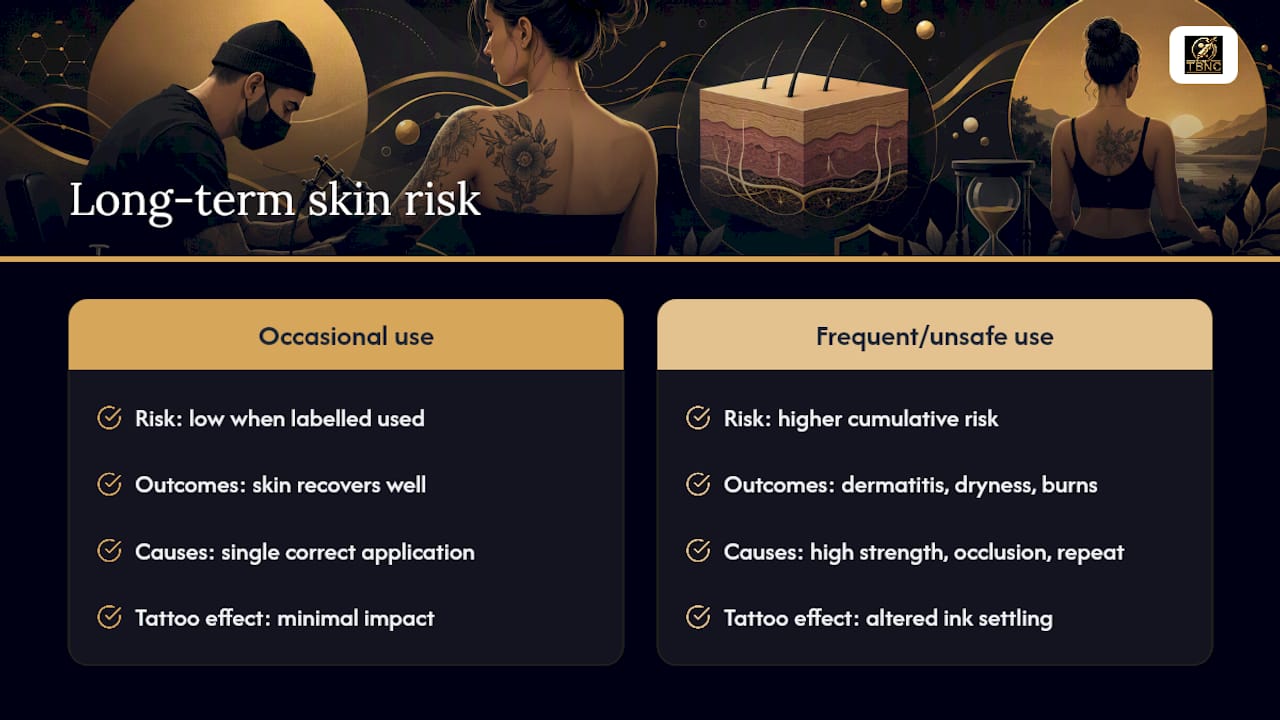
Occasional use of an approved-strength numbing product before a tattoo session doesn’t carry known long-term skin risks when the label’s instructions are followed. The concern shows up with frequent, high-concentration, or occluded use over time, not with a single properly applied session.
Repeated exposure to numbing agents at unsafe strengths or with prolonged occlusion can contribute to contact dermatitis, dryness, and in more severe cases, chemical burns that leave lasting texture or pigment changes at the site. This matters most for collectors doing back-to-back large-scale work, where the temptation to numb every session heavily is highest.
Vasoconstriction is a related, less obvious consideration. Some numbing agents temporarily narrow blood vessels at the application site, which can affect how ink settles during tattooing. This is one reason some artists prefer numbing applied and removed before needlework begins, rather than reapplied mid-session.
The skin itself generally recovers well from occasional, correctly dosed use. The pattern that causes cumulative damage is the same pattern that causes acute toxicity: too much product, too often, sealed under wrap for too long. Spacing out large projects and sticking to OTC strength keeps both short-term and long-term risk low.
Storing Numbing Products So They Stay Effective and Safe
Numbing creams and gels degrade over time, and a product past its shelf life doesn’t just work less well, it can also become less predictable in how it behaves on skin. Most topical anesthetic products carry a shelf life of one to two years unopened, with shorter windows once opened and exposed to air.
Store numbing products at room temperature, away from direct sunlight and humidity. Bathroom cabinets, despite being the default storage spot in most households, expose products to heat and moisture that can break down the active ingredient faster than the label’s shelf-life estimate assumes. A cool, dry drawer works better.
Always check the expiration date before a session, and never use a product where the texture, color, or smell has changed noticeably from when it was fresh. Separated, discolored, or unusually thin formulas are signs the product has broken down and shouldn’t go anywhere near skin that’s about to be tattooed. If you’re stocking up for multiple sessions or buying in bulk, rotate older stock to the front so nothing sits past its window unused.
What Most Guides Get Wrong About Numbing Safety
Most advice on tattoo numbing splits into two unhelpful camps: blanket warnings that treat all numbing products as risky, or marketing copy that treats concentration as the only variable that matters. Both miss the point. The FDA’s own advisories make clear that strength above 4% is the primary red flag, but the second most dangerous mistake, occlusion, gets far less attention than it deserves.
Conventional wisdom tells people to “ask their artist” about numbing cream, which is reasonable but incomplete. Artists are pain management partners, not pharmacists. They can tell you what’s worked in their studio, but they can’t calculate your safe mg/kg ceiling or evaluate whether a product’s labeling meets FDA standards. That’s on the client to check before buying anything.
The mg/kg framework deserves more attention than it gets. Most people numbing for a large session have no idea their body weight sets a real ceiling on how much product is safe, and that gap in knowledge is where avoidable incidents happen. Prioritize label literacy and dose awareness over brand loyalty or concentration bragging rights. A correctly dosed 4% product beats an unregulated “maximum strength” cream every time.
— The Best Numbing Cream
Numbing Products Built Around These Same Rules
TBNC Tattoo designs its lineup around the exact safety principles this article covers: OTC-compliant lidocaine strength, clear label instructions, and formulas dermatologists have signed off on. For a full-day session, the Ultra Tattoo Numbing Bundle pairs numbing cream with complementary aftercare so you’re covered before and after the needle, without piecing together products from different brands with different instructions.
For a single session or a first-time try, the TBNC 2 Pack gives you two applications at a manageable price point. Studios and repeat collectors managing multiple clients or sessions can order the TBNC 10 Pack to keep bulk supply on hand without running short mid-week. Every product ships with clear application instructions and OTC-compliant strength labeling, so you’re never guessing at dose or timing. Check the product pages for full label details, then order the option that matches your next session.
This article is general information, not a substitute for advice from a qualified doctor. Consult a qualified healthcare professional about your own circumstances before acting on anything here.
Sources
- FDA warns consumers to avoid certain topical pain-relief products due to potential for dangerous health effects
- Lidocaine - StatPearls - NCBI Bookshelf
FAQ
Why Do Tattoo Artists Say Not to Use Numbing Cream?
Some artists worry numbing cream causes vasoconstriction that affects ink deposition, or that it masks pain signals that normally help them gauge pressure and depth. Others simply prefer to monitor a client’s real-time reactions rather than manage a numbed session.
Are There Any Downsides to Numbing Cream for Tattoos?
Downsides include skin irritation, allergic reactions, uneven numbing that wears off mid-session, and serious systemic toxicity risk if a high-strength or occluded product is misused. Sticking to a 4% OTC lidocaine product and following label instructions minimizes most of these risks.
Is Numbing Spray Safe for Tattoos?
Numbing sprays follow the same safety rules as creams: they’re safe within OTC lidocaine limits and when not applied to broken skin or oversaturated areas. Sprays used mid-session on already-broken skin carry higher absorption risk than pre-session application on intact skin.
Can a Tattoo Artist Tell If I Used Numbing Cream?
Experienced artists often notice reduced bleeding, a slightly different needle response, or the skin’s altered texture from vasoconstriction, so many can tell. Being upfront about numbing cream use before the session lets your artist adjust technique and helps them watch for any unusual reactions.


