

Flip the Bottle: Best Tattoo Aftercare Soap for New Tattoos
A gentle, fragrance-free, dye-free cleanser is widely recommended as the best tattoo aftercare soap. Wash the tattoo twice daily with lukewarm water, using clean fingertips and a small amount of a mild, non-sulfate formula, then pat it dry with a paper towel. A tattoo foaming soap and unscented aftercare lotion cover both halves of that routine: gentle cleansing, then barrier-friendly moisture, both built around dermatologist-informed principles.
TL;DR:
- Choose a fragrance-free, dye-free cleanser with mild surfactants like syndets or tattoo-specific foaming soaps to reduce irritation during healing.
- Avoid products with fragrances, harsh sulfates, essential oils, antibacterial agents, artificial dyes, or exfoliating particles, as these can damage the healing skin.
- Use liquid syndet cleansers for sensitive skin, foaming soaps for oily skin, and avoid bar soaps unless they are specifically formulated for tattoos and listed with glycerin or oils near the top.
- Switch from a thicker ointment to a lightweight, fragrance-free lotion once the tattoo stops weeping, typically within three to five days, to avoid trapping excess moisture.
- Always follow your tattoo artist’s aftercare instructions and refrain from scrubbing or soaking the tattoo to prevent setbacks during healing.
Table of Contents
- What to Look for on a Best Tattoo Aftercare Soap Label
- Which Cleanser Format Actually Fits Your Skin?
- How to Wash a Fresh Tattoo Without Undoing the Work
- What to Avoid: The Aftercare Mistakes That Cause Real Damage
- The Dermatologist Consensus Behind This Routine
- Why Most Aftercare Advice Overcomplicates a Simple Job
- A Ready-Made Kit if You Don’t Want to Shop Ingredient by Ingredient
- Sources
- FAQ
What to Look for on a Best Tattoo Aftercare Soap Label
Fresh tattoo, meet open wound. That is exactly how dermatologists frame it: the tattooing needle punctures the skin thousands of times per minute, and the goal of cleansing isn’t disinfection so much as removing plasma and lint without stripping the lipids that support barrier repair. That distinction changes which soap belongs in your bathroom during healing.
Start with the word “fragrance-free,” and read it literally. It means no added scent at all. “Unscented” is a softer, sneakier label. Manufacturers can add a masking fragrance to cancel out the smell of raw ingredients and still call the product unscented, which is why the ingredient list matters more than the front-of-bottle claim. Scan for “parfum” or “fragrance” buried in the fine print. If either word shows up, skip it, no matter what the label promises.
Beyond fragrance, a short checklist separates a safe cleanser from one that will fight your healing skin:
- Avoid: sodium lauryl sulfate or sodium laureth sulfate (SLS/SLES), drying alcohols, essential oils, antibacterial actives like triclosan, artificial dyes, and exfoliating acids or scrub particles.
- Look for: glycerin, ceramides, mild syndet surfactants such as coco-glucoside, a pH-balanced formula, and a short, recognizable ingredient list.
- Red flag rule of thumb: if you need a chemistry degree to parse the back label, put it back on the shelf.
Even plant-derived ingredients aren’t automatically safe. Essential oils and certain botanical extracts can trigger contact dermatitis on skin that’s still an open wound, regardless of how “natural” the packaging looks. For the first two weeks, less genuinely is more.
Bar soap versus liquid is worth settling early. Traditional bar soaps built with harsh detergents dry out skin and encourage the kind of friction that irritates fresh ink. Liquid syndet or foaming formats reduce that friction since you’re not rubbing a solid bar against inflamed skin, which is why most tattoo artists steer clients toward a pump or foaming bottle early in healing. A cold-process bar soap can work if it’s formulated specifically for tattoos and lists oils or saponified butters near the top of the ingredient panel, ahead of water, but that’s a narrower exception than a rule.
Pro Tip: Flip the bottle over before you check the price. If “fragrance” appears anywhere in the first ten ingredients, the “sensitive skin” claim on the front label is marketing, not a fact.
For a deeper walkthrough of exactly which ingredients to flag, TBNC Tattoo’s guide to fragrance-free tattoo soap breaks the label-reading habit down product by product.
Which Cleanser Format Actually Fits Your Skin?
Not every “gentle” cleanser fits every skin type, and format matters as much as ingredient list. Three categories cover almost everyone healing a new tattoo.
Gentle liquid syndet cleansers (the kind marketed for sensitive facial skin) work well for dry or easily irritated skin because they clean without pulling moisture out of the barrier. Check the label for glycerin or ceramides near the top, and confirm the surfactant is a mild one like coco-glucoside or decyl glucoside rather than a sulfate. These formulas tend to run thin and lotion-like, so you’ll use more per wash than you expect.
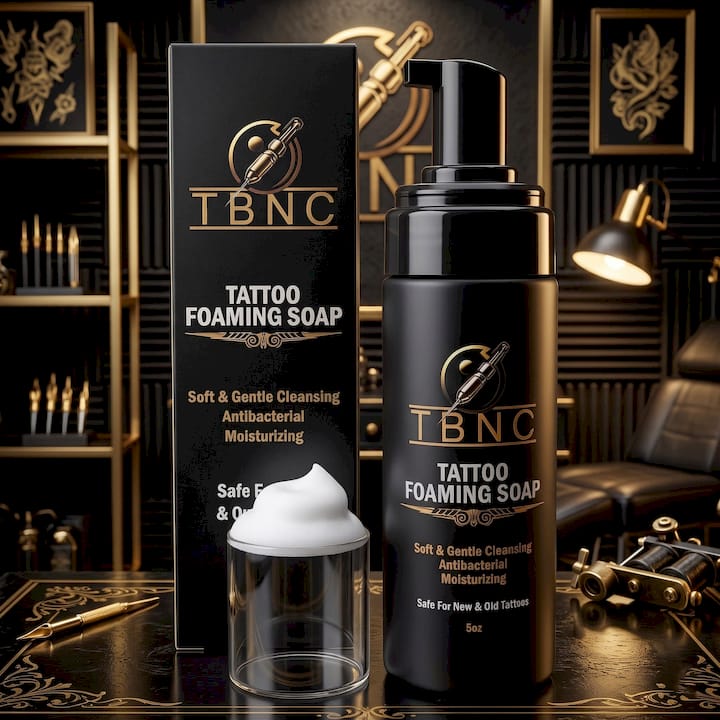
Foaming soaps built specifically for tattoos solve a practical problem: they dispense in a light, low-friction lather that rinses clean without scrubbing. That matters most for oily skin types, where a heavier lotion cleanser can feel greasy or clog healing pores. TBNC Tattoo’s Tattoo Foaming Soap fits this category, formulated fragrance-free and dye-free specifically for the twice-daily wash routine, with a foam consistency that needs no scrubbing to lift plasma and ointment residue.
Cold-process bar soaps can work for people who simply prefer bar soap, but they’re the pickiest category to shop. The safe versions retain glycerin and list saponified oils or butters early in the ingredient order, rather than leading with detergents or water. If you have sensitive or reactive skin, skip bar soap for the first two weeks entirely and default to liquid.
Here’s how the categories stack up against skin type and healing stage:
| Cleanser Format | Best For | What to Check on the Label |
|---|---|---|
| Liquid syndet / gentle facial cleanser | Dry, easily irritated skin | Glycerin or ceramides listed high, no sulfates |
| Tattoo foaming soap | Oily skin, daily convenience, early healing | Fragrance-free confirmed on ingredients, not just front label |
| Cold-process bar soap | Normal skin, personal preference for bar format | Oils/butters listed before water, no SLS/SLES |
A full aftercare routine needs more than a cleanser, and this is where a lot of people shortchange themselves. Cleansing removes contaminants; moisturizing rebuilds the barrier once the tattoo stops weeping. TBNC Tattoo’s unscented aftercare lotion is built for that second phase: lightweight enough not to clog healing skin, but formulated without fragrance or dye so it won’t undo the work the gentle soap already did. For the first few days, when the tattoo needs a slightly heavier occlusive layer, the Tattoo Aftercare Balm sits between ointment and lotion, thick enough to protect but not so heavy it traps excess moisture against inflamed skin.
Budget-wise, expect to spend more on a dedicated tattoo cleanser than on a drugstore bar of soap, but less than you’d think. Most foaming soap and lotion combinations land in the same price range as a mid-tier skincare cleanser, and a single bottle typically lasts through one or two full tattoo healing cycles depending on the size of the piece. If you’re covering a larger tattoo or multiple sessions, buying a Tattoo Numbing & Aftercare Bundle up front usually costs less per ounce than buying the cleanser and lotion separately.
How to Wash a Fresh Tattoo Without Undoing the Work
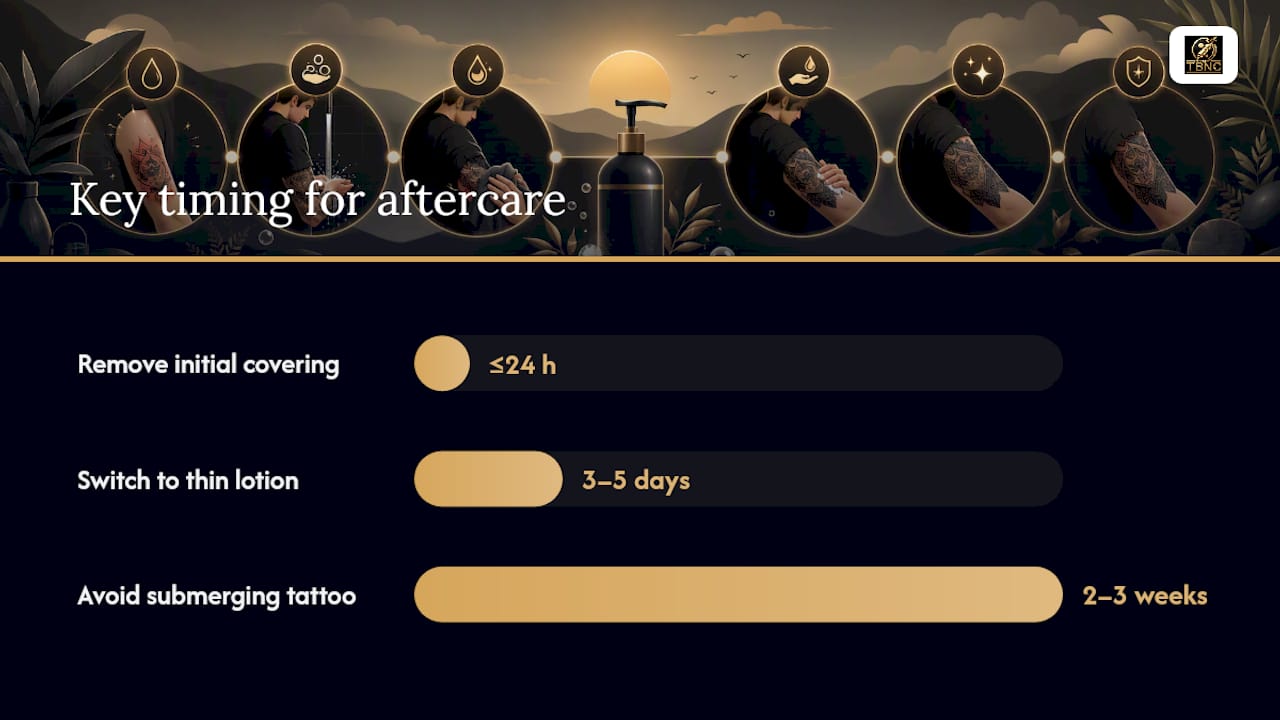
Your artist’s aftercare sheet outranks any generic advice you read online, including this. Most studios recommend removing the initial covering somewhere between a few hours and 24 hours after the session, and that window is the one instruction worth confirming directly with the person who did your ink.
Once the covering comes off, the wash routine itself is simple:
- Wash your hands thoroughly before touching the tattoo at all.
- Wet the area with lukewarm water. Skip hot water, which strips the skin further.
- Apply a small amount of your gentle, fragrance-free cleanser directly to your fingertips.
- Wash with light fingertip pressure only. No washcloths, no loofahs, no scrubbing.
- Rinse thoroughly until no cleanser residue remains.
- Pat dry with a clean paper towel rather than a bath towel, which can harbor bacteria and snag on scabbing skin.
- Apply a thin layer of ointment or balm as your artist or product instructions direct.
Repeat this twice daily, and add an extra wash after anything that leaves sweat, dirt, or fabric residue on the tattoo, like a workout or a long day in dusty conditions. Dermatologist guidance from the Cleveland Clinic backs the twice-daily frequency specifically, and it holds regardless of which gentle cleanser you choose.
Avoid submerging the tattoo entirely for at least two to three weeks. That means no baths, no pools, no lakes, and no long soaks in the shower with the tattoo directly under the stream. Henry Ford Health’s aftercare guidance specifically flags soaking as one of the more common ways people slow down their own healing.
One timing question comes up constantly: when do you switch from a thicker ointment to a lighter lotion? The signal is weeping, not the calendar. Once the tattoo stops oozing plasma, typically within the first three to five days for most pieces, it’s time to move to a thinner, fragrance-free lotion. Continuing heavy ointment past that point traps moisture against skin that no longer needs it, which can slow healing rather than speed it. If you notice spreading redness, a fever, or discharge that looks yellow or green rather than clear, that’s outside the scope of home care. Contact a clinician.
What to Avoid: The Aftercare Mistakes That Cause Real Damage
Scrubbing is the single most common way people sabotage their own healing. Friction against a fresh tattoo reopens micro-injuries, increases scabbing, and can pull pigment out of the skin before it has settled, which is the opposite of what anyone wants after paying for the work.
Over-washing causes a quieter version of the same problem. Washing more than twice daily, or scrubbing “just to be safe,” strips the skin’s natural oils faster than they can regenerate, leaving the barrier drier and more reactive than an under-washed tattoo would be.
The product list to avoid is straightforward once you know the categories:
- Fragranced soaps and body washes, including ones labeled “for sensitive skin” if fragrance appears in the ingredients
- Essential oils, even diluted ones marketed as soothing
- Sulfate-based cleansers (SLS/SLES)
- Antibacterial hand or body washes with active ingredients like triclosan
- Colored or dyed soaps
- Alcohol-based cleansers or toners
- Exfoliating acids, scrubs, or textured washcloths
Petroleum-based ointments have a real but limited role. They protect the surface during the first few weeping days, but long-term occlusive use can trap moisture and delay healing rather than help it, which is why the routine shifts to lighter lotion once weeping stops. Similarly, antibiotic ointments and antiseptic products aren’t recommended for routine use unless a clinician has specifically diagnosed an infection, since they can irritate healing skin without a clear medical benefit.
Watch for spreading redness beyond the tattoo’s edges, increasing pain after the first few days rather than decreasing, fever, or discharge that’s thick, yellow, or foul-smelling. Those signs point toward infection rather than normal healing, and they warrant a call to a doctor rather than another home remedy. If something feels off, comparing your symptoms against a checklist of tattoo infection signs can help you decide how urgently to act.
The Dermatologist Consensus Behind This Routine
Strip away the marketing language on most tattoo aftercare products and the underlying medical advice is remarkably consistent. The Cleveland Clinic, the American Academy of Dermatology, and European dermatology guidance from EADV all converge on the same three points: clean with something gentle and fragrance-free, wash twice a day, and avoid scrubbing or routine antiseptics.
A fresh tattoo heals faster when the skin barrier is disturbed as little as possible. That means minimal ingredients, minimal friction, and moisture that’s added deliberately rather than trapped accidentally under heavy ointment.
An aftercare line is built around that exact framework rather than reinventing it. A tattoo foaming soap is formulated fragrance-free and dye-free, meant to handle the twice-daily wash without the friction of a bar or washcloth. An unscented aftercare lotion picks up once weeping stops, delivering the hypoallergenic, moisture-retaining care that the AAD recommends for that second healing phase. Neither product claims to replace medical care. Both are built to match the label checklist any dermatologist would hand you.
Why Most Aftercare Advice Overcomplicates a Simple Job
The tattoo aftercare industry loves to sell complexity. Serums, “healing accelerators,” specialty balms with a dozen active ingredients, all promising faster or better results than plain gentle cleansing. Strip the marketing away and the dermatological consensus hasn’t changed in years: clean, gentle, fragrance-free, twice a day. That’s it.
Where conventional advice actually falls short isn’t the routine itself. It’s the label-reading step people skip entirely. Most buyers grab whatever bottle says “sensitive skin” or “unscented” on the front and never flip it over. That single habit, checking for “fragrance” or “parfum” in the actual ingredient list, prevents more irritation than any specialty ingredient ever will.
If you take one thing from this guide, take this: prioritize the ingredient list over the marketing claim, every single time. A five-ingredient cleanser without fragrance beats a fifteen-ingredient one with a “calming botanical blend” listed near the top, because the second bottle is betting your healing skin can handle plant extracts it’s never been exposed to before. Simple wins. It always has.
— The Best Numbing Cream
A Ready-Made Kit if You Don’t Want to Shop Ingredient by Ingredient
Reading ingredient labels at 11 PM after a fresh tattoo session isn’t every collector’s idea of a good time, and you shouldn’t have to become a chemist just to heal properly. TBNC Tattoo’s Tattoo Numbing & Aftercare Bundle packages the cleanser, lotion, and balm together so every product in your routine is already checked against the same fragrance-free, dye-free standard, rather than you cross-referencing five different bottles from five different brands.
The bundle maps directly onto the routine covered above: use foaming soap for the twice-daily wash, switch to unscented lotion once weeping stops, and reach for balm during the first few days when your tattoo needs a slightly heavier protective layer. No guessing which product does what, and no separate purchases to coordinate timing across. If you’d rather build your own combination, the individual Tattoo Aftercare Bundle offers similar contents as a standalone option. Either way, the products ship ready to use from day one of your healing window.
Sources
This guide draws its core recommendations from established dermatology and wound-care resources rather than tattoo-industry marketing alone:
- Tattoo aftercare: How to care for a new tattoo | Cleveland Clinic
- Caring for tattooed skin | American Academy of Dermatology (AAD)
- How to care for your tattoo so it always looks great | Henry Ford Health
- What soap for tattoo on sensitive skin: Guide to gentle aftercare | Sortra
FAQ
What is the best soap to wash a new tattoo?
A gentle, fragrance-free, dye-free cleanser with mild surfactants, like a syndet liquid soap or a dedicated tattoo foaming soap, is the safest choice for cleaning a new tattoo twice daily.
What soap should you avoid after getting a tattoo?
Avoid soaps with added fragrance or “parfum,” sulfates like SLS/SLES, essential oils, antibacterial actives, artificial dyes, and exfoliating scrubs or acids, since all of these can irritate healing skin and delay recovery.
Is Aquaphor or Cerave better for tattoos?
Both serve different roles rather than competing directly: petroleum-based ointments like Aquaphor work best for the first few weeping days, while a gentle, fragrance-free lotion like Cerave (or TBNC Tattoo’s unscented aftercare lotion) takes over once weeping stops and the skin needs lighter, ongoing moisture.
What do tattoo artists recommend for tattoo cleaning?
Most tattoo artists recommend washing with lukewarm water and a fragrance-free, gentle cleanser twice a day, using only fingertips rather than a washcloth, then patting the area dry and applying a thin layer of ointment or lotion as healing progresses.


