

Tattoo Numbing and Pregnancy: What You Need to Know
The short answer: most medical sources advise waiting to get a new tattoo until after pregnancy and breastfeeding, and numbing cream is a medication, so it belongs in a conversation with your ob-gyn before it goes anywhere near your skin. If you are pregnant and tattoo-curious, the safest plan is to book the session for later and use the wait to learn how numbing works, so you walk in prepared. If you are planning a tattoo after the baby arrives, or you are an artist whose clients ask this question, this guide gives you the facts and the limits that matter.
TL;DR
- Major sources, including the American Pregnancy Association and the WHO/IARC tattoo FAQ, recommend waiting until after pregnancy (and breastfeeding) for a new tattoo.
- Topical lidocaine has no adequate human pregnancy studies. AFP guidance says to use it only when the benefit outweighs the risk, and after the first trimester at the earliest.
- The FDA’s 2024 consumer warning: no OTC pain relief above 4% lidocaine, no heavy application over large areas or broken skin, and no plastic wrap over treated skin.
- Belly, hip and breast tattoos can stretch and change shape with pregnancy, so timing affects how the art looks as well as safety.
- Ask your ob-gyn before using any numbing product while pregnant. Plan your numbed session for after delivery and breastfeeding.
Table of Contents
- Why pregnancy changes the tattoo conversation
- Is numbing cream safe during pregnancy?
- The FDA’s 2024 warning, in practical terms
- What to ask your ob-gyn
- Timing matters for the art as well
- Planning your post-pregnancy session
- Perspective
- When you are ready: numbing and aftercare in one place
- FAQ
- Sources
Why pregnancy changes the tattoo conversation
A tattoo means thousands of needle punctures. Normally that is a comfort and pain question. During pregnancy it becomes a health question, for three reasons the research keeps returning to.
First, infection. Healthline notes pregnancy can weaken the immune system, which makes infection more likely. The FDA reports that contaminated tattoo inks have caused infections, and that even sealed inks can harbor microorganisms.
Second, ink itself. The WHO/IARC tattoo programme explains that during tattooing the ink contacts blood and lymphatic fluids, and so potentially the placenta and breast milk. Its advice is precautionary: wait until after breastfeeding. Australia’s Pregnancy, Birth and Baby service says there is no clear evidence either way, and that the safest option is to wait.
Third, your skin. WebMD reports that melasma and increased sensitivity can change how a tattoo looks and how you react to the process.
That is why a first-time client asking “can I just numb it and go ahead?” is asking two questions at once: is the tattoo okay right now, and is the numbing okay right now. Neither has a clean green light.
Is numbing cream safe during pregnancy?
The honest answer from the medical literature is “it depends, and it needs a clinician’s sign-off.”
Tattoo numbing creams work by temporarily blocking nerve signals in the skin. The active ingredient is usually lidocaine, sometimes with other “-caine” anesthetics. Here is what the evidence says about the common ones.
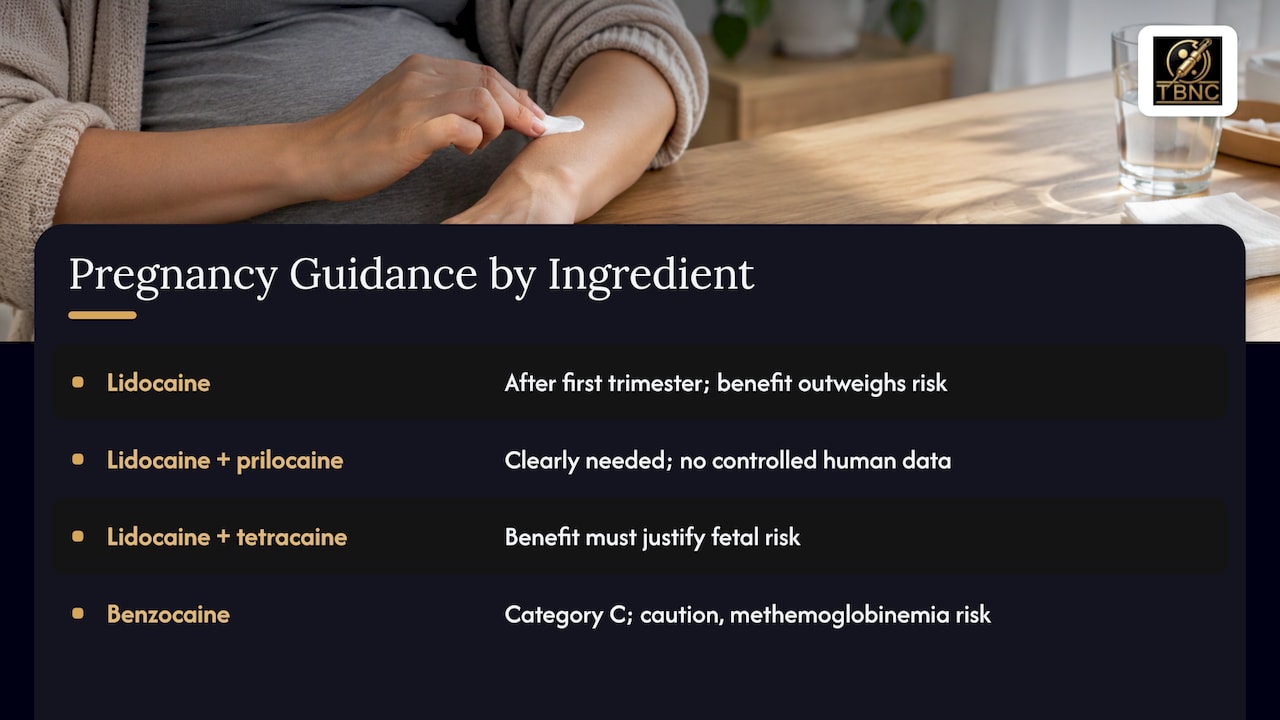
Lidocaine. The American Family Physician review of over-the-counter medications in pregnancy notes that topical lidocaine at 4 to 5% has only 1 to 3% bioavailability, meaning very little reaches the bloodstream when used as directed on intact skin. It does cross the placenta, and it is considered acceptable after the first trimester, only when the potential benefit to the mother outweighs the potential risk to the fetus. Because there are no adequate human studies, the same review advises using the lowest effective dose for the shortest time.
Lidocaine and prilocaine. Drugs.com lists this combination as pregnancy category B with no controlled human pregnancy data, recommended only when the benefit outweighs the risk. The FDA label for lidocaine 2.5% and prilocaine 2.5% cream says to use it in pregnancy only if clearly needed, and warns that local anesthetics can cause methemoglobinemia, a serious condition in which blood carries less oxygen. A peer-reviewed review of cosmetic procedures in pregnancy adds that prilocaine in high doses carries a risk of fetal methemoglobinemia, so such creams should be used in moderation and without occlusion.
Lidocaine and tetracaine. The FDA label for the prescription product PLIAGLIS says to use it in pregnancy only if the potential benefit justifies the fetal risk, and that application to broken or inflamed skin can lead to toxic blood concentrations.
Benzocaine. A PDR-based reference lists benzocaine as pregnancy risk category C, to be used with caution, and associated with methemoglobinemia.
If you want a plain-language comparison of how these ingredients behave on tattoo skin, our guide to lidocaine vs. prilocaine vs. tetracaine covers it.
What the FDA allows over the counter
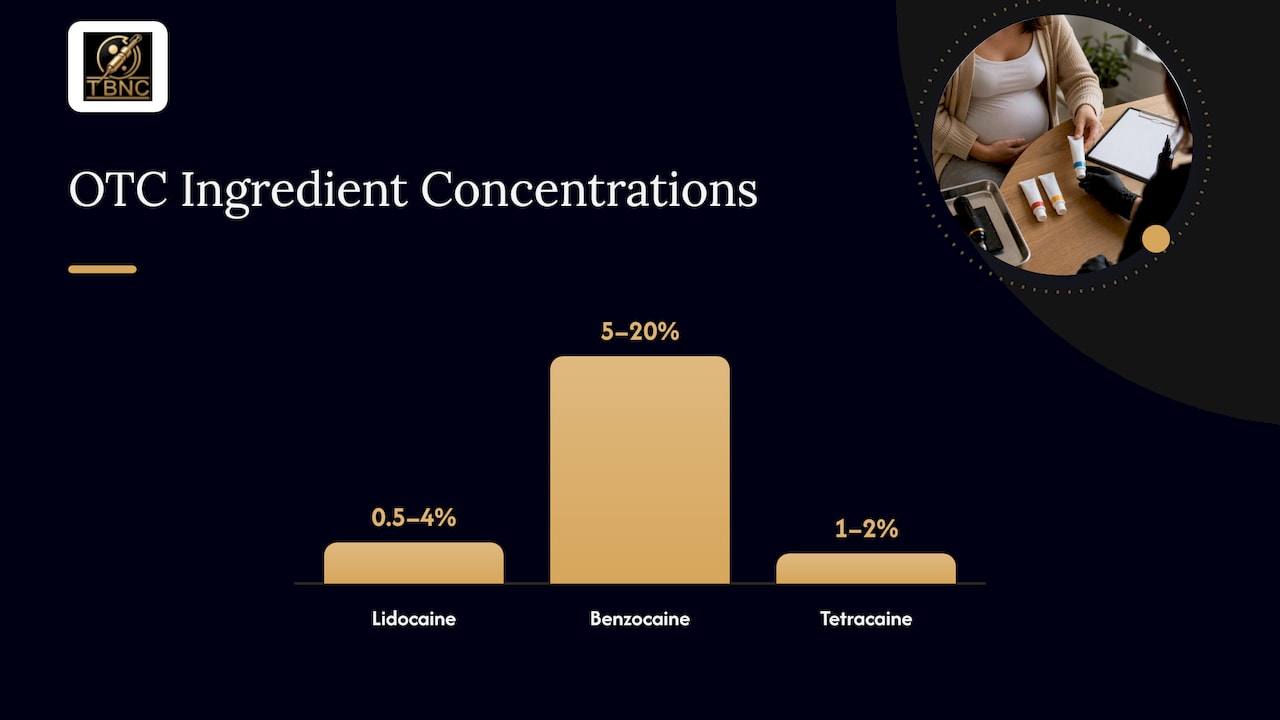
Under the FDA’s external analgesic monograph, over-the-counter products may contain lidocaine at 0.5 to 4%, benzocaine at 5 to 20% and tetracaine at 1 to 2%, and a product may not combine more than one “-caine” active ingredient. In plain terms, 4% is the ceiling for nonprescription lidocaine. Our explainer on the FDA’s 4% lidocaine limit shows how that limit plays out on sensitive areas.
The FDA’s 2024 warning, in practical terms
On March 26, 2024, the FDA warned consumers away from certain OTC topical pain relief products marketed for use before, during or after cosmetic procedures such as tattooing, and sent warning letters to six companies. Some of the products contained lidocaine above permitted OTC concentrations, and increased skin absorption can cause irregular heartbeat, seizures or breathing difficulties.
Its consumer recommendations are simple, and they apply to everyone, pregnant or not:
- Do not use OTC pain relief products with more than 4% lidocaine on your skin.
- Do not apply them heavily over large areas, or to irritated or broken skin.
- Do not wrap treated skin in plastic wrap or any dressing, because covering increases absorption.
For anyone who is pregnant, these are the minimum rules, not a clearance. Lower absorption is exactly what the pregnancy literature asks for, which is why the amount and the area matter so much. Our guides on how much numbing cream is safe and the 5 mg/kg check for tattoo numbing explain how to size an application.
What to ask your ob-gyn
ACOG advises contacting your ob-gyn about any over-the-counter product with an ingredient that is not on its safe list, and reviewing with them any medication you use for your skin. A numbing cream is exactly that kind of product. Bring the product box or ingredient list to the appointment and ask:
- Which active ingredient and what percentage is in this product, and is it acceptable at my stage of pregnancy?
- How much, over what area, and for how long could I use it?
- Does anything about my health history (anemia, heart rhythm, medications) change the answer?
- If I am breastfeeding, does the timing change?
The American Pregnancy Association also notes that no study has conclusively shown back tattoos prevent epidurals, so that worry should not be the deciding factor either way. Your clinician is the right person to weigh your own situation.
Timing matters for the art as well
Even if health were not a concern, pregnancy is a poor canvas. Healthline explains that when skin stretches, a tattoo stretches with it, and that pregnancy is the factor most likely to change a tattoo’s look. Stretch marks develop in about 8 out of 10 pregnant people, and rapid stretching and shrinking can leave loose skin, especially on the belly, hips, buttocks, breasts and thighs.
A 2010 review in the European Journal of Obstetrics & Gynecology and Reproductive Biology notes tattoos may become distorted if placed on a distended area. In a Cosmopolitan roundup, ob-gyn Mary Jane Minkin, MD suggests waiting at least six weeks after birth, noting that weight changes and skin stretching may take longer to settle.
For collectors, the practical lesson is to design around your body’s timeline. A large piece on the ribs, stomach or thigh is better drawn once your body has settled, so the artist works on the skin that will actually carry the tattoo for years.
Planning your post-pregnancy session
A good plan for a session after delivery and breastfeeding looks like this:
- Get clearance first. Confirm with your own clinician that you are ready, particularly if you are still nursing.
- Pick a placement that has settled. Give stretched areas time before committing.
- Talk to your artist about numbing. Our page on numbing cream and tattoo artists lists what to settle before you book, since many artists want to know in advance what is on your skin.
- Measure, do not guess. Stay at or under the 4% OTC lidocaine ceiling, keep to a modest area and skip plastic wrap, as the FDA advises.
- Plan aftercare in advance. Healing skin needs gentle cleansing and moisture from day one.
If you are planning a back piece, our back tattoo numbing guide walks through prep and timing for the area people most often ask about.
Drug-free comfort while you wait
If you are mid-pregnancy and simply want to manage everyday discomfort without medication, there are drug-free pain management options that can sit alongside whatever your clinician recommends. They are for general comfort now, not a substitute for the planning above.
Perspective
Every week someone asks us whether they can numb a tattoo while pregnant. We answer the way we want every client to hear it: the best session is the one you book when you are ready, and not a day sooner.
Our numbing line is built around lidocaine, the ingredient tattoo artists know best, and our formulas are designed for deep, long-lasting numbing so a long sitting stays comfortable. That is a promise for a body that is ready for a tattoo. During pregnancy, your ob-gyn decides what goes on your skin, and the medical guidance on waiting is clear.
What we can do is help you prepare. Learn the 4% rule, learn how much is enough, and line up numbing and aftercare so that when the day comes you can relax in the chair. A calm first session is a better first tattoo.
The Best Numbing Cream
When you are ready: numbing and aftercare in one place
Once your clinician has cleared you and your tattoo date is set, TBNC Tattoo carries numbing and aftercare in one line. Tattoo numbing cream starts at $15.95, with numbing gel at $16.95 and numbing spray at $18.95. For healing, the range includes foaming soap at $14.95, balm at $11.95, soothing gel at $14.95, butter from $15.95 and unscented lotion at $15.95. If you would rather buy everything together, the Tattoo Numbing & Aftercare Bundle covers the session and the healing weeks. Our formulas are dermatologist-approved, and over 3,250 studios worldwide use TBNC.
FAQ
Is it safe to get a tattoo while pregnant?
Most medical sources advise waiting. The American Pregnancy Association points to infection risk and unknown effects of ink chemicals, particularly in the first 12 weeks, and recommends waiting until after the baby is born. The WHO/IARC tattoo FAQ advises waiting until after breastfeeding as well.
Is numbing cream safe during pregnancy?
There are no adequate human studies, so guidance says to use topical lidocaine only when the benefit outweighs the risk, and not in the first trimester. Ask your ob-gyn before using any numbing product, and follow the FDA’s limits on strength, area and covering.
Will my tattoo stretch during pregnancy?
Yes, it can. Tattoos on the belly, hips, breasts and thighs are most affected, because the skin there stretches and may leave stretch marks or loose skin afterward. Many people wait until their body has settled after birth before getting or touching up work in those areas.
Can I get my existing tattoo touched up or removed while pregnant?
Touch-ups and removal involve the same skin-breaking and healing concerns as a new tattoo, so bring them up with your ob-gyn and plan them for after delivery and breastfeeding. Meanwhile, gentle moisturizing keeps existing tattoos comfortable as your skin changes.
Sources
- Can I get a tattoo if I’m pregnant? (Healthline)
- Think Before You Ink: Tattoo Safety (FDA)
- Cosmetic procedures and beauty treatments during pregnancy (Pregnancy, Birth and Baby)
- Tattooing: FAQ (WHO/IARC)
- Tattoos and Pregnancy (American Pregnancy Association)
- Is It Safe to Get a Tattoo While Pregnant or Breastfeeding? (WebMD)
- Over-the-Counter Medications in Pregnancy (AFP)
- Lidocaine / prilocaine topical use during pregnancy (Drugs.com)
- Lidocaine and prilocaine cream label (DailyMed)
- Dermatologic and Cosmetic Procedures in Pregnancy (PMC)
- PLIAGLIS label (FDA)
- Benzocaine reference (PDR, 2018)
- External Analgesic Drug Products OTC Monograph M017 (FDA)
- FDA Warns Consumers to Avoid Certain Topical Pain Relief Products (FDA)
- Skin Conditions During Pregnancy (ACOG)
- Tattoo Stretching: Why It Happens (Healthline)
- Body art and pregnancy (PubMed)
- Can You Get a Tattoo While Pregnant: 3 Doctors (Cosmopolitan)


