

Dermatologist Backed Color Tattoo Aftercare to Preserve Color Vibrancy
Wash your fresh color tattoo twice a day with lukewarm water and a mild, fragrance-free soap, pat it dry, then smooth on a thin layer of a fragrance-free moisturizer or dermatologist-approved aftercare balm. Skip soaking, direct sun, and picking at scabs. That combination, followed consistently for the first two to three weeks, is what actually protects saturated color and keeps complications away. Some aftercare lines are formulated around these principles and used across networks of studios.
TL;DR:
- Proper aftercare involves gentle, twice-daily washing with fragrance-free soap, followed by a thin layer of dermatologist-recommended moisturizer, to protect pigment during healing.
- The surface of the tattoo typically heals in two to three weeks, but pigment stabilizes over several months, making sun protection crucial long-term.
- Petroleum-based products should only be used briefly if advised by your artist, with ongoing use limited to fragrance-free, water-based moisturizers and balms.
- Sun exposure accelerates fading, so daily SPF 30 or higher is essential once the tattoo is fully healed, with SPF50+ providing additional hydration benefits.
- Signs of complications include spreading redness or discharge indicating infection, and localized bumps or rashes suggesting pigment allergy, which require prompt medical attention.
Table of Contents
- How Do You Care For a Color Tattoo in the First Two Weeks?
- What Does the Color Tattoo Healing Process Look Like Over Time?
- Which Ingredients Protect Color and Which Ones Dull It?
- How Do You Protect Tattoo Color From Sun Fading Long-Term?
- What Are the Signs of Infection or Allergic Reaction on a New Tattoo?
- Why Trust This Color Tattoo Aftercare Routine?
- The Part of Tattoo Aftercare Everyone Gets Backward
- Building the Right Aftercare Kit for Your Color Tattoo
- Sources
- FAQ
How Do You Care For a Color Tattoo in the First Two Weeks?
The first fourteen days decide a lot about how your color looks in five years. Skin is still repairing itself at the surface, and whatever you do (or don’t do) during this window either locks pigment in place or gives it a reason to fade early.
Step 1: Remove the bandage the way your artist told you to. Most studios wrap fresh work in plastic film or a specialty covering like Saniderm. Leave it on for the timeframe your artist specifies, usually anywhere from a few hours to a couple of days, then remove it slowly. If it sticks, run it under warm water for a minute before peeling. Never rip it off dry.
Step 2: Wash gently, twice daily. Use clean hands, lukewarm water, and a mild, fragrance-free soap. Work up a light lather, rinse thoroughly, and stop. No washcloths, no loofahs, no scrubbing motion. Your tattoo needs a fragrance-free soap, not whatever bar soap happens to be in the shower. Pat the area dry with a clean paper towel rather than a bath towel, since fabric towels can snag on tender skin and reintroduce bacteria.
Step 3: Moisturize with a thin layer. Once the skin is dry, apply a light coat of a recommended aftercare product. Dermatologists at Cleveland Clinic note this exact rhythm, cleaning twice a day, patting dry, then a thin layer of moisturizer, as the routine that supports healing without smothering the skin. Watch for over-moisturizing: if the tattoo looks shiny, greasy, or starts weeping excess product back out, you’re using too much.
Step 4: Let it scab and flake without interfering. Light scabbing and peeling are normal and expected. Itching usually follows. Resist scratching. A light tap with a clean finger or a fresh layer of moisturizer calms the itch far better than nails do, and picking a scab early risks pulling pigment out with it.
A few rules make or break this window:
Do:
- Wash twice daily, no more.
- Wear loose, breathable clothing over the area.
- Keep bedding clean and change it more often than usual.
- Apply aftercare product every time skin starts to feel tight or dry.
Don’t:
- Soak in bathtubs, pools, or hot tubs until fully healed.
- Use petroleum-heavy ointments for more than the first day or two.
- Wear tight waistbands, bra straps, or shoes over the tattoo.
- Pick, scratch, or peel scabs manually.
Pro Tip: Keep a travel-size moisturizer in your bag during week one. Dry skin tightens and cracks fastest when you’re out and can’t reapply, and cracked skin is where pigment loss actually starts.
What Does the Color Tattoo Healing Process Look Like Over Time?
Color tattoos don’t heal on one timeline. The surface closes up fast; the deeper layer where pigment actually sits takes much longer to settle, and that gap is where most people get impatient and stop protecting their ink too soon.
- Days 1 to 6: The tattoo is an open wound. Expect redness, mild swelling, and some oozing of plasma and excess ink. Wash it, pat it dry, moisturize lightly, and don’t touch it otherwise.
- Days 7 to 21: Scabs form and start flaking off. Color often looks cloudy or dull underneath the peeling skin, this is dead surface skin, not the actual pigment fading. It resolves once the flaking finishes.
- Weeks 4 to 12 and beyond: The visible surface looks healed, but the dermal layer where color lives is still stabilizing. Cleveland Clinic points out that superficial healing often wraps up in about two to three weeks, while deeper settling can run for months.
That gap between “looks healed” and “is actually healed” is the single biggest reason people lose vibrancy they didn’t have to lose. Stopping sun protection and moisturizing the moment scabs fall off leaves color exposed during the exact months it’s still locking into place.
Which Ingredients Protect Color and Which Ones Dull It?
Simple wins over complicated here. A tattoo mid-healing is disrupted skin, and the more ingredients you throw at it, the higher the odds one of them causes irritation instead of helping.
Stick to fragrance-free, water-based lotions or a dermatologist-recommended balm. The American Academy of Dermatology specifically warns against petroleum-based products for anything beyond the first day or two, since they can clog pores and contribute to fading over time. A tattoo healing lotion applied once the initial ointment phase ends tends to work better for the middle stretch of healing than a heavy occlusive product does.
On soap: mild and fragrance-free is the standard. Antibacterial soap is acceptable if that’s what your artist recommends, but it isn’t mandatory for every case, plain gentle cleansers do the job for most people. What matters more than the antibacterial label is avoiding scented, dye-heavy, or exfoliating washes entirely.
One ingredient worth knowing by name: dexpanthenol. In two exploratory clinical studies, a dexpanthenol-containing wash and SPF50+ sun-care product were well tolerated and helped maintain hydration while preserving the cosmetic appearance of tattoos exposed to sunlight. It’s one of the few ingredients with actual study data behind it rather than just tradition.
- Fragrance-free, water-based lotion: yes, ongoing.
- Petroleum-heavy ointment: only if your artist advises it, and only briefly.
- Antibacterial soap: fine if preferred, not required.
- Essential oils, “natural” multi-ingredient balms: avoid during healing.
How Do You Protect Tattoo Color From Sun Fading Long-Term?
UV light breaks down pigment particles sitting in the dermis, which is why a tattoo that gets regular sun exposure without protection fades noticeably faster than one that doesn’t. This isn’t a healing-phase issue only, it’s a lifetime issue, but the habits you build in month one tend to stick.
Wait until the tattoo has fully re-epithelialized, meaning no open skin or scabbing, before applying sunscreen directly over it. Once healed, broad-spectrum SPF 30 or higher, applied daily, is the baseline. The same clinical research on dexpanthenol sun-care found that SPF50+ formulations offered a meaningful edge in preserving hydration and appearance under sun exposure, which suggests going higher than the SPF 30 minimum is worth it for tattooed skin specifically.
- Apply sunscreen to healed tattoos daily, and reapply regularly when outdoors.
- Cover fresh tattoos with loose clothing instead of sunscreen during the healing window.
- Skip tanning beds entirely; they deliver concentrated UV with none of the benefit.
- For swimming or sports, wait until fully healed, then use water-resistant SPF and reapply after towel-drying.
A tattoo sunscreen routine built around consistent daily application will do more for long-term color than any single product choice during the healing phase.
What Are the Signs of Infection or Allergic Reaction on a New Tattoo?
Most healing irritation is normal. Some signs aren’t, and catching them early changes the outcome.
Infection warning signs include increasing pain rather than gradually improving pain, redness that spreads outward from the tattoo instead of staying contained, yellow or green discharge, a foul odor, or fever. The FDA has documented infections tied to contaminated inks and advises contacting a health professional promptly if you notice these symptoms.
Allergic reactions can show up differently, sometimes weeks or even years after the tattoo was done. Color-specific rashes, raised bumps localized to one pigment, or persistent itching in just one color area point toward a pigment allergy rather than an infection. Red ink is commonly implicated, but any color can trigger a reaction.
If something looks wrong:
- Photograph the area daily so you and a provider can track changes.
- Contact your artist for the ink brand and lot number.
- See a physician or dermatologist rather than waiting it out.
- Report suspected contaminated ink to the FDA through its consumer safety channel.
Pro Tip: Save your artist’s ink brand info from day one, before you ever need it. If a reaction shows up later, having that lot number on hand speeds up diagnosis considerably.
Spreading redness with fever warrants urgent care the same day. A persistent itchy bump with no other symptoms can usually wait for a scheduled dermatology visit.
Why Trust This Color Tattoo Aftercare Routine?
This routine isn’t a house opinion. It’s a synthesis of dermatology guidance and regulatory warnings that all point the same direction.
Cleveland Clinic and the American Academy of Dermatology both recommend the same core sequence: gentle cleaning, fragrance-free moisturizing, and avoiding petroleum-heavy products for ongoing use. The FDA has separately flagged contaminated inks as a real infection risk, which is why hygiene during the healing window matters as much as the product you choose.
Two exploratory clinical studies found that a dexpanthenol wash and SPF50+ sun-care product were well tolerated and helped preserve tattoo hydration and cosmetic appearance during sun exposure, giving one of the few ingredient choices in this space actual trial data behind it.
- Dermatologist-backed cleaning and moisturizing sequence, not guesswork.
- FDA-documented infection risks tied specifically to contaminated inks.
- Clinical evidence for dexpanthenol supporting hydration and appearance.
- Some aftercare lines are formulated around these principles and used across networks of studios.
The Part of Tattoo Aftercare Everyone Gets Backward
Most aftercare advice treats color tattoos like any other wound: keep it clean, keep it moist, wait for it to close. That’s incomplete. Wound healing and color preservation are related but not identical goals, and treating them as the same thing is where a lot of people lose vibrancy they never needed to lose.
The surface heals in two to three weeks. Pigment settles for months. The conventional advice mostly stops mattering to people right when the visible scabbing ends, which is precisely the point where sun exposure and inconsistent moisturizing start doing quiet damage to a tattoo that looks fine but isn’t done stabilizing.
If there’s one thing to prioritize above the rest, it’s this: keep the routine going past the point where the tattoo looks healed. Sunscreen and moisturizer in month two matter more for color retention than almost anything you do in week one, because week one gets all the attention and month two gets none. That imbalance is the real gap in most aftercare advice, not the cleaning instructions, which are usually fine.
— The Best Numbing Cream
Building the Right Aftercare Kit for Your Color Tattoo
Matching the right product to the right stage of healing is where a lot of people improvise and get it wrong. Some aftercare lines are built around the same phases dermatologists describe, reducing guesswork about what to use and when.
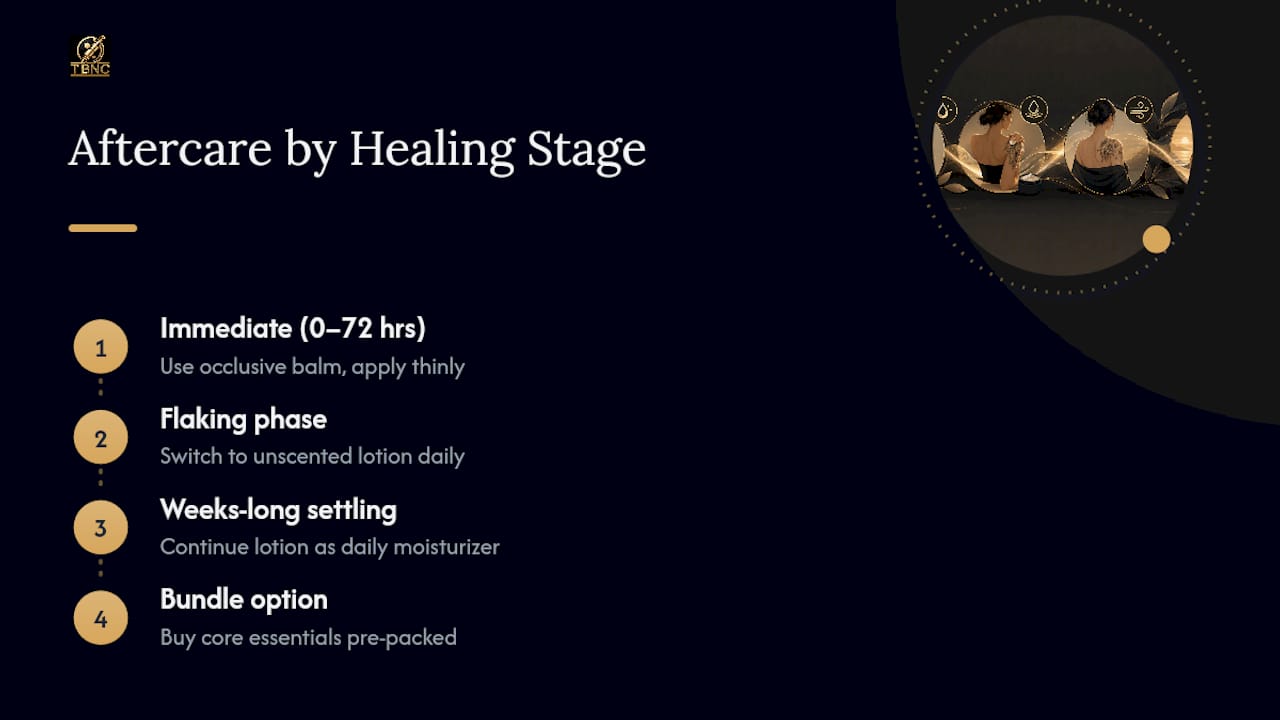
Early on, if your artist recommends an occlusive layer for the first 24 to 72 hours, the Tattoo Aftercare Balm works as that initial protective layer, applied thin, with clean hands or a single-use spatula to avoid introducing bacteria into the tub. Once that early phase passes and skin starts flaking, switch to something lighter. The unscented aftercare lotion is formulated fragrance-free specifically because scented products are one of the more common irritants on healing skin, and it becomes your daily moisturizer through the weeks-long settling period.
If you’d rather not piece products together individually, the Basic Tattoo Aftercare Bundle packages the core essentials into one order, which is the simpler route for anyone getting their first color piece and unsure exactly what to buy. Store everything at room temperature, away from direct sun, and always apply with clean hands. Check the bundle now to have the right products on hand before your ink even hits the chair.
Sources
Claims in this guide draw on Cleveland Clinic’s tattoo aftercare guidance, the American Academy of Dermatology’s skin care recommendations, the FDA’s tattoo safety warnings on ink contamination and infection, and a clinical study on dexpanthenol wash and sun-care for tattooed skin. For deeper reading on specific steps, see the guide on fragrance-free tattoo soap and the 30-day aftercare routine.
- Tattoo Aftercare: Instructions and Healing Tips — Cleveland Clinic
- Tattoos: Skin care and reactions — American Academy of Dermatology
- Think you ink? Tattoo safety — FDA
- Clinical evaluation of dexpanthenol-containing wash and sun-care for tattooed skin — PMC
FAQ
What Is the Best Aftercare for a Color Tattoo?
Wash twice daily with lukewarm water and mild, fragrance-free soap, pat dry, then apply a thin layer of a fragrance-free moisturizer or dermatologist-approved balm, avoiding sun and soaking until fully healed.
Do Color Tattoos Take Longer to Heal Than Black Ink?
Not typically for the surface wound itself, both usually re-epithelialize within two to three weeks, but color pigment can take several months of deeper dermal settling before it’s fully stable and sun-safe.
How Often Do Color Tattoos Need Touch-Ups?
This varies widely by placement, sun exposure, and skin type, but consistent daily sunscreen and moisturizing after healing significantly reduces how often fading requires a touch-up session.
What Does a Color Tattoo Look Like While Healing?
Expect redness and slight oozing in the first week, followed by scabbing and flaking through week two or three, during which the color often looks temporarily dull or cloudy under the peeling skin before brightening back up.


