

Acne-Prone Tattoo Aftercare: Heal Ink Without Breakouts
If your skin breaks out easily, a fresh tattoo can feel like a risk: an open, healing surface that you are told to moisturize, which is exactly what clogged pores dislike. The answer is a lighter routine, not a heavier one. Wash gently, use a thin layer of an unscented moisturizer, keep the area breathable, and never pick at anything that appears. Our unscented Tattoo Aftercare Lotion and Tattoo Foaming Soap are built for exactly that simple wash-then-moisturize rhythm.
This guide covers the routine, the mistakes that trigger tattoo pimples, what to do when one shows up, and the signs that mean it is not acne at all.
TL;DR
- Wait for an active breakout to clear before you get tattooed, and tell your artist you are acne-prone.
- Wash gently with warm water and mild soap, then moisturize with a thin layer of unscented lotion. Too much product is a common cause of tattoo pimples.
- Never pop, pick or scratch. Skip benzoyl peroxide and salicylic acid on a new tattoo.
- Hard, warm, swollen skin, pus, fever or a bumpy rash inside the design means see a doctor or dermatologist.
Table of Contents
- Why acne-prone skin and fresh tattoos clash
- Before the session: timing and prep
- The first two weeks: a minimal routine
- Ingredients that deserve a second look
- What to do when a pimple appears
- Is it acne, an allergy or an infection?
- After it heals: keeping acne-prone skin and ink happy
- Why a purpose-made routine beats improvising
- Our approach to acne-prone aftercare
- Build your acne-prone aftercare kit
- FAQ
- Sources
Why acne-prone skin and fresh tattoos clash
A tattoo is a controlled wound. The skin is irritated, it sheds, and it needs moisture to heal. Acne-prone skin already produces extra oil and clogs easily, so anything that traps sweat, friction or heavy product against the surface can set off bumps.
Medical News Today notes that a pimple on a tattoo does not necessarily mean infection. People with acne-prone skin can develop pimples from excess sebum, and over-applying ointment is one of the common triggers. That is good news: most of the control sits in how you treat the tattoo, not in your genes.
Three habits do most of the damage:
- Smothering. Thick layers of ointment, tight bandages and clothing that rubs.
- Over-washing or harsh products. Stripping the skin makes it overcompensate. Healthline explains that cleansing removes oil that clogs pores but also removes moisture, and without a fragrance-free moisturizer afterward, skin can produce more oil and keep the breakouts going.
- Touching. Picking opens the skin to bacteria and can pull out ink.
Before the session: timing and prep
Do not book a tattoo over an active breakout. Medical News Today advises waiting until a breakout has resolved before getting tattooed. Pimples in the stencil area also make it harder for the artist to work cleanly.
A few practical steps:
- Tell your artist your skin is acne-prone and ask how they want you to handle washing and moisturizing for your placement. Back, chest, shoulders and jawline are oilier zones, so they deserve extra thought.
- Plan for loose, clean, breathable clothing over the area.
- Stock your aftercare before the appointment so you are not improvising with whatever is in the bathroom.
- If the session will be long and you want comfort while you sit, a lidocaine product such as our Tattoo Numbing Cream (from $15.95) is part of our pre-session range. Check with your artist about using it before you book.
The first two weeks: a minimal routine
The core of acne-prone aftercare is the same as everyone’s, with the dial turned toward lightness. Cleveland Clinic’s guidance, updated March 20, 2026, says to wash a new tattoo twice daily with mild, fragrance-free, antibacterial soap and warm water, pat dry with a clean paper towel, moisturize twice a day and wear loose, breathable clothing. Your artist’s own instructions come first, so follow them where they differ.
Step 1: Take off the wrap on time
Follow your artist’s timing for removing the bandage or wrap. Leaving plastic on longer than instructed traps sweat and heat against the skin, which is the kind of environment that encourages breakouts.
Step 2: Wash gently
Use clean hands, warm (not hot) water and a mild soap. Lather with your fingertips, rinse, and pat dry with a clean paper towel rather than a shared cloth towel. Do not scrub with a washcloth or loofah. Our Tattoo Foaming Soap ($14.95) is made for this step, and a foam spreads easily without rubbing.
Step 3: Moisturize thinly
This is where acne-prone skin differs most. You want enough lotion that the skin does not tighten or crack, and no more. If the tattoo looks shiny or greasy ten minutes later, you used too much. Blot the excess with a clean paper towel.
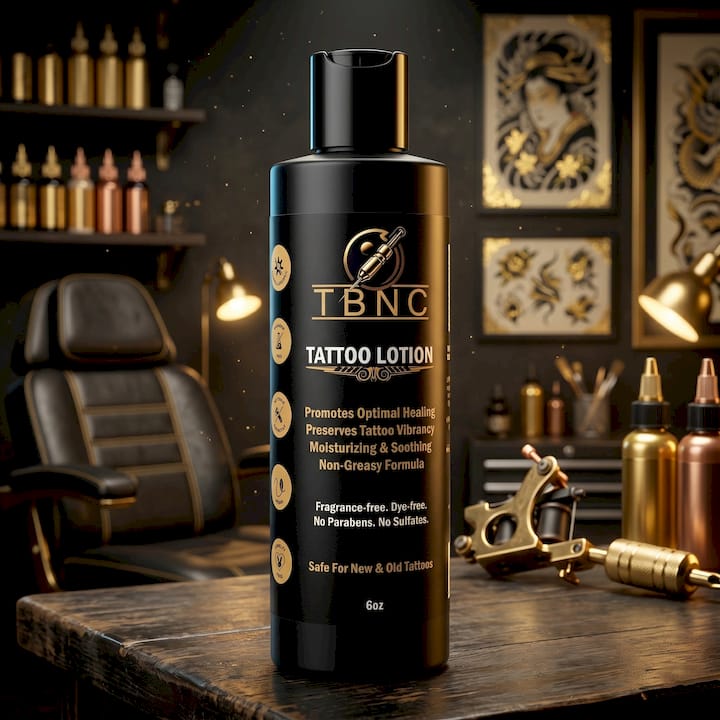
The American Academy of Dermatology (AAD) says that if tattooed skin feels dry, apply a water-based lotion or cream and avoid petroleum-based products such as petroleum jelly, which can cause ink to fade. A light lotion fits the bill. Our unscented Tattoo Aftercare Lotion is $15.95 and is designed to moisturize and soothe healing skin without fragrance.
Step 4: Skip the heavy stuff
Cleveland Clinic’s Dr. Khetarpal explains that petroleum jelly can block pores, potentially leading to bacterial overgrowth and more inflammation while the tattoo heals. For breakout-prone skin that is reason enough to avoid it. We cover the reasoning in more depth in our piece on why dermatologists steer away from petroleum jelly on new tattoos.
Step 5: Keep friction, heat and water away
Cleveland Clinic also advises avoiding tight clothing, exfoliating, and soaking in pools, hot tubs or bathtubs until the tattoo is fully healed. Sweat and rubbing are the main breakout drivers on a back or chest piece, so shower after workouts and change into clean, loose fabric. Healthline’s guidance for breakouts on tattooed skin is similar: shower regularly, wash gently with unscented soap and warm water, and wear loose clothing until the breakout clears.
A simple daily rhythm
| Time | What to do | Why it helps |
|---|---|---|
| Morning | Gentle wash, pat dry, thin layer of lotion | Removes overnight sweat and oil without stripping |
| Midday | Check clothing is loose and clean; do not touch | Cuts friction and bacteria |
| Evening | Gentle wash, pat dry, thin layer of lotion | Keeps skin balanced so it does not overproduce oil |
| After sweating | Rinse, pat dry, change clothes | Sweat trapped on healing skin invites bumps |
For a day-by-day view of what the skin does and which product fits each stage, see our 30-day tattoo aftercare plan.
Ingredients that deserve a second look
Fragrance and some preservatives irritate healing skin, and irritated skin breaks out. When you read a label, think of the ingredient list as a short filter: unscented, nothing medicated, nothing exfoliating, nothing heavy and waxy. Our guide to ingredients to avoid after a tattoo walks through the usual offenders.
A note on popular drugstore lotions: whether a specific brand suits your skin depends on its formula and on how your skin reacts. Patch it on a small area of healed skin near the tattoo first, and use the same rule as for any product: thin layer, unscented, stop if you see new bumps or itching.
What to do when a pimple appears
First, do not touch it. Healthline’s medically reviewed guidance says popping, scratching or picking a pimple on a new tattoo exposes it to bacteria, raises infection risk and can displace new ink, causing patchy faded spots or scarring. On an old tattoo, picking can still scar.
Then work through this order:
- Back off the product. If you have been applying lotion three or four times a day, cut back to a thin layer twice a day.
- Wash gently. Warm water and mild soap, no scrubbing.
- Loosen up. Switch to looser clothing and avoid heat, sweat and friction.
- Wait. Many pimples go away without treatment. Healthline lists whiteheads, blackheads, red tender bumps and bumps that leak fluid as typical acne-type breakouts.
That gentler-care-first approach is the one the Medical News Today guidance leans on: it points out that over-application of ointment and allergy to ointment ingredients are common triggers, so the first response is to ease off before reaching for medicated products.
Acne products: new tattoo versus healed tattoo
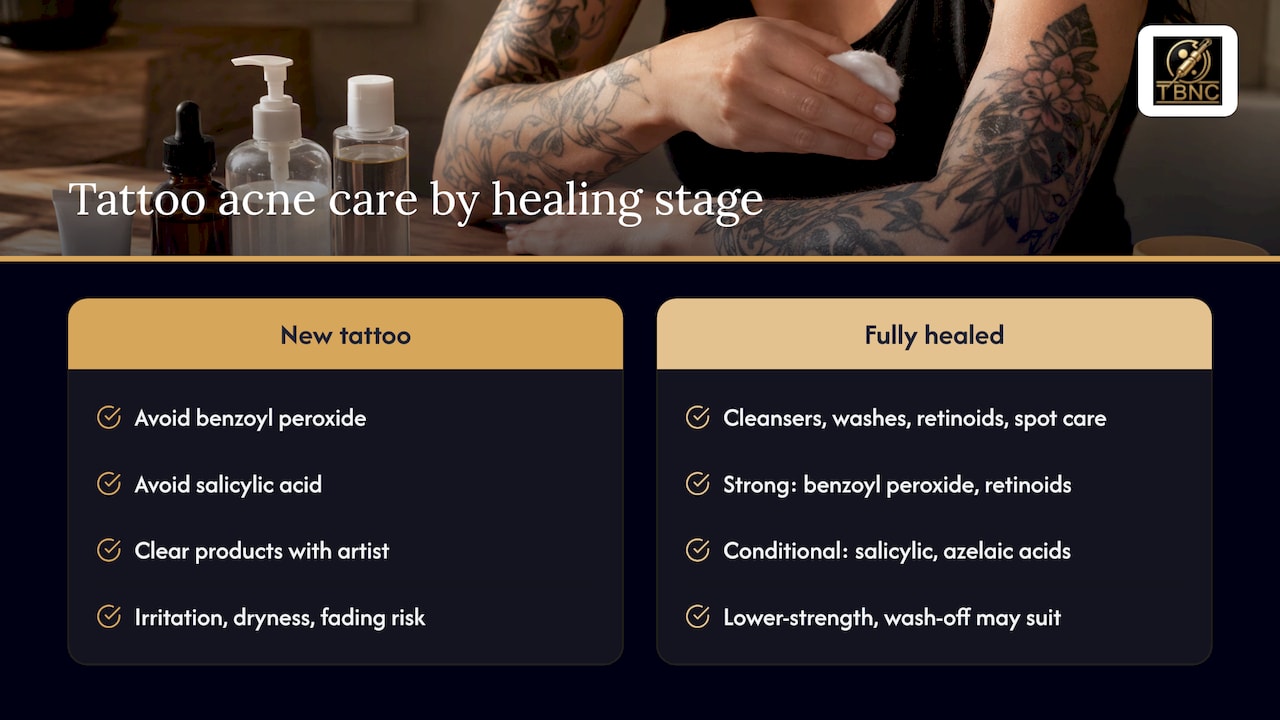
On a new tattoo, avoid benzoyl peroxide and salicylic acid. They can irritate and excessively dry the skin, which impairs healing. Healthline adds that you should not use acne-fighting products on a tattoo without clearing it with your artist, because ingredients like salicylic acid could clear the pimple but leave spotty color or unexpected fading.
Once the tattoo is fully healed, more options open up. Medical News Today lists anti-acne cleansers, salicylic acid or benzoyl peroxide washes, topical retinoids and over-the-counter spot treatments for healed tattoos. The American Academy of Dermatology’s 2024 acne guidelines, published in the Journal of the American Academy of Dermatology, strongly recommend benzoyl peroxide and topical retinoids and conditionally recommend salicylic acid and azelaic acid, and note that lower benzoyl peroxide concentrations and wash-off formulations may be better tolerated. Introduce one product at a time, and keep an eye on whether the ink looks different afterward.
Can you use a pimple patch on a tattoo?
Medical News Today includes over-the-counter spot treatments, such as hydrocolloid pimple patches, among the options for pimples on fully healed tattoos. On a fresh tattoo, skip them: adhesive can pull on healing skin, hold in moisture and disturb peeling or scabbing. That is our own caution, drawn from the same principle that thin, breathable care heals best.
How long is “healed”?
Cleveland Clinic’s Dr. Khetarpal says the top layer of skin is typically healed by about two months, though deeper layers can take several more months. Because the surface can look healed well before the deeper skin is, be conservative about switching on strong actives. If you are unsure, ask your artist.
Is it acne, an allergy or an infection?
Most tattoo pimples are just that. But some reactions need a professional, and you should know the difference.
Signs of infection. The AAD lists redness that darkens or spreads, pain that continues or worsens, a rash of itchy red painful bumps within the tattoo, fever, chills, pus or open sores, and says to see a doctor or board-certified dermatologist right away if any appear. Medical News Today adds hard tissue, warm or swollen skin and fluid buildup to the list of reasons to get care. Cleveland Clinic says antibiotics are the common treatment, sometimes more than one for up to six weeks, which is why early attention matters. Our overview of tattoo infection signs helps you compare what you see.
Signs of an ink allergy. The AAD says allergies most often affect one color, with red often the culprit, and can appear right away or weeks, years or even decades later. They can look like redness, swelling, itch, small pimple-like bumps, raised scaly patches, lumps, blisters or crusting. A mild or moderate reaction that lasts longer than one to two weeks warrants a visit to a board-certified dermatologist. Trouble breathing, a racing heart, chest tightness, dizziness, intense swelling, flushing or hives need immediate medical care.
A practical test: acne-type bumps are scattered, show up across colors and clear as you ease off product. Bumps confined to one color, bumps that keep returning in the same pattern, or anything with pain, heat or pus should be looked at by a professional.
After it heals: keeping acne-prone skin and ink happy
Once the tattoo is healed, your regular acne routine can mostly return, with sunscreen as the new non-negotiable. The AAD recommends broad-spectrum, water-resistant sunscreen of SPF 30 or higher, applied 15 minutes before sun exposure and reapplied at least every two hours, and says to avoid tanning beds and sunlamps, which can fade ink. Cleveland Clinic cautions against putting sunscreen on a tattoo that is still healing, so cover it with clothing until it is closed over. Our guides on when to use sunscreen on a tattoo and sun on a new tattoo cover the timing in detail.
If you want the lotion step to carry on after healing, a light unscented moisturizer keeps skin balanced so it does not overproduce oil. Many collectors also use a tattoo brightening lotion on healed ink to maintain vibrancy.
Why a purpose-made routine beats improvising
The usual path for acne-prone people is trial and error: a drugstore cleanser with an acne ingredient, a heavy ointment because someone said so, then a pimple patch on day four. Every one of those choices is the kind the research above warns against for a new tattoo. A routine built from a gentle soap and an unscented lotion removes the guesswork, and it keeps the number of products on healing skin low, which is the heart of acne-prone aftercare.
Our approach to acne-prone aftercare
At TBNC we think of aftercare as a short list done well. Our aftercare line covers a foaming soap, a balm, a soothing gel, a butter and an unscented lotion, all designed to speed healing, reduce irritation, moisturize and maintain tattoo vibrancy.
For clients whose skin breaks out, we point people to the simplest pairing: our Tattoo Foaming Soap to cleanse and our unscented Tattoo Aftercare Lotion to moisturize. Fewer products, thin layers, and nothing that irritates is how we would want any healing tattoo treated.
Our formulas are dermatologist-approved and made with skin-friendly ingredients, and they are designed not to affect ink quality or healing. Our products are trusted by over 3,250 tattoo studios worldwide and have been used in over one million tattoo sessions, so we understand how much a clean, comfortable heal matters to artists and clients alike.
The Best Numbing Cream
Build your acne-prone aftercare kit
For a clean, low-product heal, start with the two basics: Tattoo Foaming Soap at $14.95 for washing and Tattoo Aftercare Lotion, Unscented at $15.95 for moisturizing. The rest of the range, including the Tattoo Balm at $11.95, Tattoo Soothing Gel at $14.95 and Tattoo Butter from $15.95, is on our aftercare collection page. Artists and studios can also order in bulk.
FAQ
Can I get a tattoo if I have acne?
Yes, as long as the area you are getting tattooed is free of active breakouts. Medical News Today advises waiting until a breakout has resolved first. Tell your artist about your skin type so you can agree on a washing and moisturizing plan.
How do I treat tattoo acne?
Do not pop, pick or scratch. On a new tattoo, wash gently with warm water and mild soap, use less lotion, wear loose clothing and avoid sweat and friction. Avoid benzoyl peroxide and salicylic acid until the tattoo is fully healed, and ask your artist before using any acne product on the ink.
Can I put a pimple patch on a healed tattoo?
On a fully healed tattoo, spot treatments such as pimple patches are among the options Medical News Today lists. Stop using one if redness, itching or irritation appears. On a fresh tattoo, patches should stay off because the adhesive can pull on healing skin.
What moisturizer is best for acne-prone skin on a new tattoo?
Choose a water-based, unscented lotion and apply a thin layer twice a day, as the AAD and Cleveland Clinic advise. Avoid petroleum jelly, which can block pores. Our unscented Tattoo Aftercare Lotion is made for healing tattooed skin.
When should I see a doctor about bumps on my tattoo?
See a doctor or board-certified dermatologist if you have hard, warm or swollen skin, pus, fever, chills, spreading redness or worsening pain, or if bumps do not clear with gentle care. Seek immediate medical care for trouble breathing, a racing heart, dizziness or hives.
Sources
- Pimples on tattoos: Causes, treatments, and prevention, Medical News Today
- Caring for tattooed skin, American Academy of Dermatology
- Tattoos: 7 unexpected skin reactions and what to do about them, American Academy of Dermatology
- Tattoo Aftercare: Instructions and Healing Tips, Cleveland Clinic
- Tattoo Infection: Signs, Causes, Treatment and Prevention, Cleveland Clinic
- Tattoo Rash: Pimple, Allergy Symptom, or Infection?, Healthline
- Pimple on Tattoo: Is It Safe to Pop or Treat?, Healthline
- Guidelines of care for the management of acne vulgaris, Journal of the American Academy of Dermatology


